




Today we’d like to introduce you to Roy Anderson.
So, before we jump into specific questions, why don’t you give us some details about you and your story.
I started my journey in taiko 20 years ago. Just for reference – the word “taiko” literally means “drum” in Japanese. Outside of Japan, it refers to various drums and the practice of Wadaiko, also known as Japanese drumming. It also can refer to the name of a performing group such as in Ronin Taiko.
Taiko dates back over 2000 years. It was played ar shrines and in temples. It was also used in wartime, helping to set the marching pace on the battlefield. Artistically, it was played in theatrical settings for Kabuki or Noh plays.
The specific style I play and teach is called kumi-daiko (set of drums). This style is rather new in that it has only been performed since 1951 when a Japanese Jazz musician named Daihachi Oguchi, was given an old piece of written taiko music. Finding this music difficult to read with its traditional and esoteric notation, he decided to “jazz it up” literally.
Oguchi added multiple taiko players on different-sized instruments, creating more of an ensemble.
In 2000, I visited a Japanese Museum for their annual Hatsume Festival. (It is a celebration of the first bud of spring.) It was there where I saw a local taiko group performing. I later joined that group and soon began performing with them. I added certain elements of my martial arts training and demonstrations to the pieces, making them more theatrical. During that time, I started traveling to Japan to learn more about the art. I trained with several groups in Japan- most notably ASKA-GUMI Mai Daiko and Miyake-Jima Geino Doushi-Kai, two very prominent and specialized troupes in Japan. After a time, I founded Ronin Taiko along with Malia Anderson and Eddie Yates in 2006 and began performing as a professional taiko group.
Overall, has it been relatively smooth? If not, what were some of the struggles along the way?
Since the art form was new to most people when I started, it was sometimes difficult for some people to accept that I myself wasn’t Japanese. Since we were usually booked by telephone, some clients would assume that all our performers were Japanese or Asian. One on the first questions would be based on our race. It seemed they weren’t as interested in professionalism, athleticism or playing ability as they were in our ethnic appearance. We often have to work much harder as a result for acceptance. To be acknowledged as a genuine performer and able to play is certainly worth the effort.
Taiko drums are made from rawhide covering a wooden shell usually cut from a single tree. The drums are very expensive and require ongoing maintenance. (In Japan, some of the best leather goes to making taiko, unlike other places, where the best leather is used for luxury items such as car interiors for example). The wooden shells are stored away for years to dry out so they won’t crack over time. This helps the drums keep a good sound.
Please tell us about Ronin Taiko & the Taiko Academy.
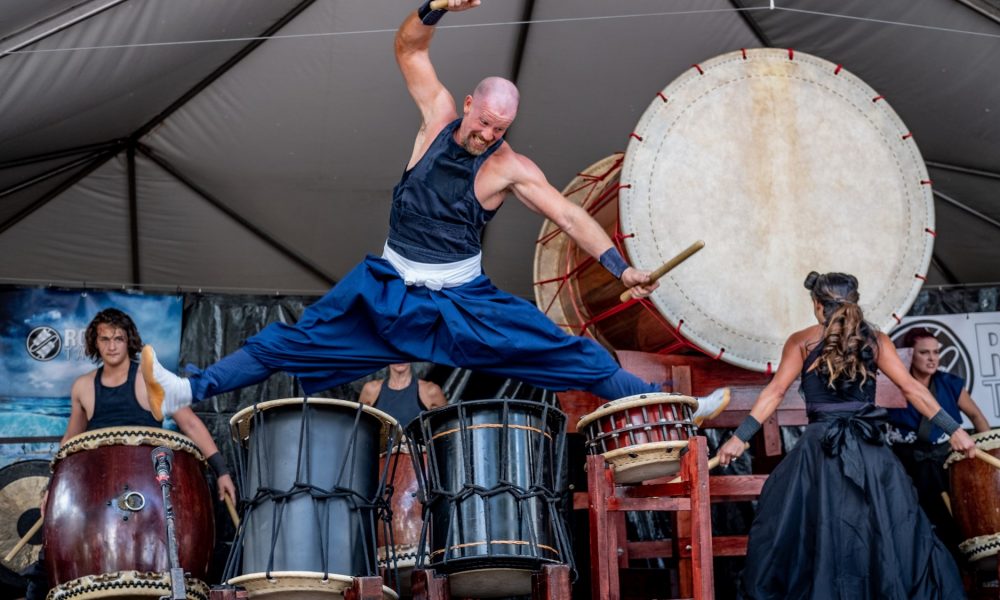
Ronin Taiko is a Fort Lauderdale based Japanese Drum Troupe that practices and performs the art of taiko. Through powerful sounds, energetic movements, and the use of theatrics, Ronin Taiko has developed a unique passionate dedication to the traditions of taiko drumming and performance. Being able to practice, perform and share this unique art to as many people as possible, in doing so, helping to break down stereotypes. It allows for interesting musical collaborations with other groups ranging from theatres to performing at a variety of festivals- even joining the sounds of bagpipes and percussion via Tribal pipe and drum band such as CuDubh. Having an extensive background in the fitness industry, I also work as an educator in the field of Personal Training and Fitness. Combining the two physical disciplines, I created “Taiko Fitness” classes, which give people the opportunity to physically train and drum.
The best of both worlds!
Contact Info:
- Address: 2664 NW 31st Avenue
Lauderdale Lakes, FL 33311 - Website: RoninTaiko.com
- Phone: 9547704700
- Email: [email protected]
- Facebook: https://www.facebook.com/ronintaikodrumtroupe/


 Image Credit:
George Quiroga, Sveinn Kjartansson, Malia Anderson, Lynne Ingram
Suggest a story: VoyageMIA is built on recommendations from the community; it’s how we uncover hidden gems, so if you or someone you know deserves recognition please let us know here.