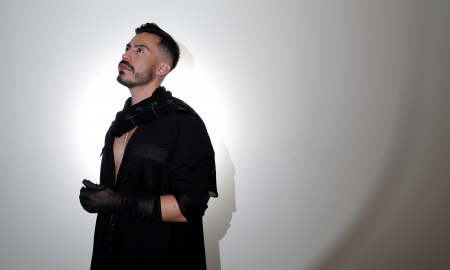



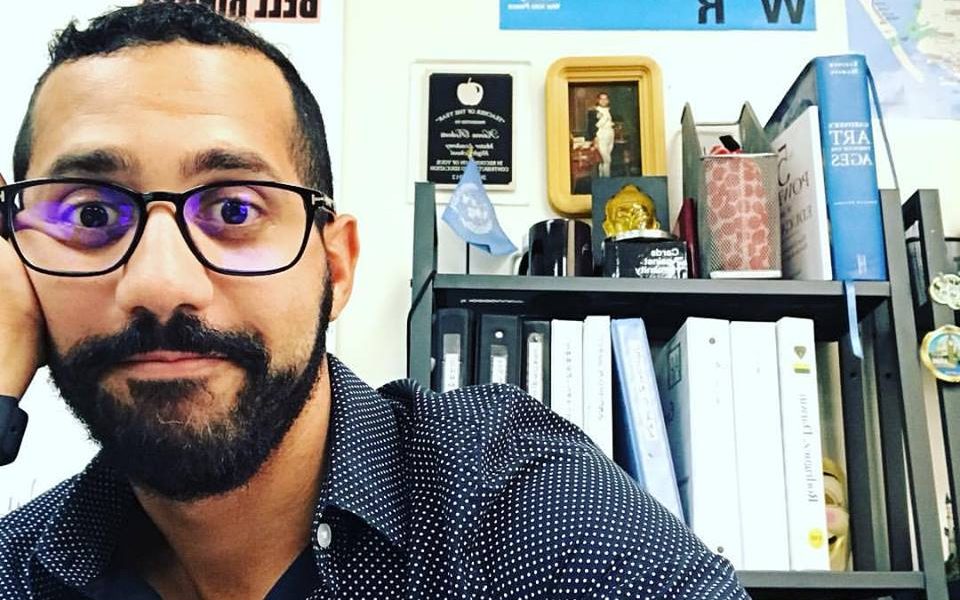
Today we’d like to introduce you to Darwin Rodriguez.
Thanks for sharing your story with us Darwin. So, let’s start at the beginning and we can move on from there.
Despite being a native New Yorker, I spent Hurricane Andrew in a closet in Hialeah with my grandma, so my roots in Miami are long and deep. I didn’t move for good until the summer of 2005 when I transferred to FIU from Oberlin College. Apparently, being of Dominican descent and racially ambiguous, as far as the locals were concerned, wasn’t the veritable walk in the quad in northeast Ohio before the age of “wokeness.”
I always excelled in the humanities, but immigrant parents are usually unimpressed with the desire of their first-born American son to study art history, so I took art history courses on the side while I pleased my parents with majors that sound more concrete, and less effete and ephemeral. Long story short, do what you love, not what others think you should.
I majored in International Relations, given my penchant for culture, languages, history, and current events. While at FIU in undergrad, I eventually became Head Delegate of FIU’s Model United Nations program. However, I was unable to parlay my intended career in diplomacy into a means of existence. I was a part time student and didn’t have the luxury of taking an unpaid internship in Washington or New York when I had very real financial obligations at home.
Upon graduation, I was lucky enough to begin working as a social studies teacher at a charter school in Hialeah. I am forever indebted to a close friend and mentor for recognizing my ability to teach before I saw it in myself. I started my career as an educator teaching Civics to 7th graders, the vast majority of whom had immigrant parents or were immigrants themselves. There were times where I experienced odd moments of self-realization given my background and my educational “audience.”
I rapidly saw my teaching load increase as I was trusted with ever more complex courses that lined up more with my interests. I came to question the narratives that are reproduced in history classrooms as I saw how too many students felt uninterested in the humanities and tried to enliven and augment curricula as often as I could. I eventually concluded my time as a High School teacher with several years of experience teaching European History, American History, and Art History. I was also fortunate enough to travel to Germany and Austria one summer selected to do study tours about European History and the Holocaust.
My pivot into museum work started several years ago. I grew up going to museums both on field-trips and thanks to my parents, and when PAMM opened, I came opening weekend. The Pérez Art Museum Miami became a refuge of sorts for me, where I saw artwork that reflected my own experiences, saw a space for genuine human interaction, and an extra added bonus was beautiful. After about five years in the classroom, I decided to pursue a Master’s degree in history, thinking at the very minimum it would improve my talents as a History teacher, and at the maximum, open up new opportunities for me.
I enrolled in FIU’s Public History Master’s Program because I saw myself as an exactly that, a Public Historian. I was fascinated by how and where people, or all sorts, ages, backgrounds, and abilities, consume what is and what is often not presented to them as “history.” One of these places where historical narratives are more visibly reproduced is in museums. My program obligated me to find a museum internship and I thought of no better place than PAMM. I taught Art History, brought my students on field trips twice a year, and above all, valued the carefully curated artwork. PAMM’s artwork lined up with my own academic areas of interest, namely the Caribbean, Africa and the African Diaspora, Europe, and the Americas. So much of Miami, its people, and its history, is tied up in the at times violent interactions and overlaps of these four geographic and cultural realms.
I hounded a contact at PAMM until she finally relented and brought me in as PAMM’s first intern. Today, she’s PAMM’s current Director of Education, Marie Vickles. I was teaching full time, going to school part time, and learning about the inquiry method and developing educational content based on PAMM’s exhibitions as a part time unpaid intern.
I received my Master’s degree in Public History in May of 2018 and started a full time position as a Teaching Artist at PAMM June of that same year, as well as teaching as an adjunct professor at FIU. I am still learning and growing as a full time museum educator and part time academic educator, and hope that the doors that I have built remain open for others to follow.
Has it been a smooth road?
My path has been anything but conventional. There are many people that major in art history and find jobs in museums straight out of college, and I didn’t start until I was 31! I think I was able to find joy in teaching, in educating, and as my role in the arts and humanities continues to evolve, I’ve come to appreciate that there really is no destination, just a journey.
Please tell us about your work.
PAMM is Miami’s flagship Art Museum. I think PAMM’s Art collection, as well as it’s the pride of place on Biscayne Bay makes for a work environment that’s not only visually gorgeous but mentally engaging.
As a teaching artist, I give daily tours to our school groups, with ages ranging from Kindergarten to High School. Every day brings new students to interact with and share the magic of museums. I teach students how to think critically, a skill that is sorely lacking in public education, using art galleries as my classroom. I know my work is executed to the best of my abilities when kids that walked in the door with grimaces leave with beaming smiles, saying, “I want to bring my whole family!” and begging me to extend my tour.
I believe that the best learning is disguised in fun, so I know my tours have an element of fun in every one of them. So much of the museum can seem like an uninviting place, considering our most important rule asks students not to use one of their most trusted senses, that of touch. I finish my tours outside to give students some freedom, breathe the air, enjoy the views, and get to interact with some of our outdoor exhibits.
Also, along with Lorie Ofir, another Teaching Artist at PAMM, I get to still get a taste of the High School classroom with our PAMM Teen Arts Council, or PTAC for short. PTAC is a group of a dozen or so high school students that work in the museum, and it’s my job to create meaningful programming for them every week. PTAC is a joy to be a part of because, in many ways, I get to be the person I needed at 16. I get to be a mentor for students that like art, history, and everything that speaks to their humanity.
Let’s touch on your thoughts about our city – what do you like the most and least?
Likes: February weather, the ever-growing art scene, living close to family, TimeOut Market
Dislikes August weather, Trying to cross Biscayne Blvd on foot, lack of mass transit to South Beach, I-95 functioning like the Berlin Wall.
Contact Info:
- Instagram: drodrig1229


Suggest a story: VoyageMIA is built on recommendations from the community; it’s how we uncover hidden gems, so if you or someone you know deserves recognition please let us know here.