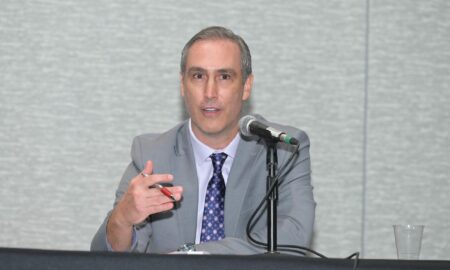





Today we’d like to introduce you to Benoit Duverneuil.
So, before we jump into specific questions about the business, why don’t you give us some details about you and your story.
I’m from Limoges, France and I moved to Florida in 2006. I have lived in Florida for the past decade. After a first career working humanitarian NGOs and startup business development with the regional French government I was drawn here by love, the sun, the great outdoors, the proximity to Central and South America, and the positive, can-do spirit of the American people!
As an only child, I grew up surrounded by literature, especially travel-fictions. From the stories of Antoine de Saint-Exupery, Jules Verne, Rudyard Kipling, Henry Rider Haggard, the letters from Arthur Rimbaud about Africa, the correspondence of Lord Byron when he traveled to the East all the way to the court of Ali Pasha, or the travels and adventures of the comic character Corto Maltese, I’ve developed an unconditional appetite for adventures beyond the horizon.
In College, I studied History, Heritage Cultural Management, and Computer Sciences. During the first years of my career, I have been involved with development projects in Western Africa and I joined a humanitarian convoy towards the end of the war in ex-Yugoslavia. A year later, I traveled to South East Asia to make a documentary about street children and the role of NGOs. When you are 20 years old, those are the kind of experiences that change you forever. You can understand the impact you can have and how important it is to share your story with a large audience. From there, I started traveling extensively, especially adventures that take you off of the beaten path.
Then, I helped many Internet startup companies with their international development strategy. I ended up creating the first International web design festival, a 24hrs event hosted simultaneously in a dozen of countries, and I’ve set up one of the very first startup accelerators in Europe which included an innovative eye-tracking lab to improve human-machine interfaces.
My career took me into Data Analysis, Robotics & AI, as well as Business Development and Entrepreneurship. I worked for fortune 500 companies and launched a few startup companies. However, Heritage Conservation and sustainability have been my main subjects of interest for the last two decades. I’ve also worked in the travel sector for many years! At every opportunity, I’d explore the remote places of our vast planet to see what remains of our cultural heritage and work with locals to preserve it in a sustainable way.
Today, I’m the founder of A.D.A.P. (Aerial Digital Archaeology & Preservation), a research group specialized in non-invasive drone technology. I am also a board member of the Taras Oceanographic Foundation and the vice-president of La Condamine, a French non-profit organization dedicated to scientific exploration.
After a few missions in South America as a volunteer (I was part of fieldwork projects led by American Universities), I realized the potential of the emerging drone technology for aerial archaeology. My first experiments started in 2008. Due to the success of these missions, I have quickly approached by both scholars and technologists. This is when my research group started. From there, we’ve expanded the scope of our research to all kind of drones, aerial, waterproof, underwater, terrestrial… sensors such as infrared, laser…. and applications with photogrammetric and 3D mapping and modeling software to 3D printing. Our work became a small revolution in the field of cultural heritage and after training hundreds of professionals, drone technology is now a common tool for cultural heritage professionals.
Has it been a smooth road?
It is never a smooth road, especially when you combine emerging technology and field work in remote locations. The drone industry is still at an early age and many experiments didn’t work as intended. Quite sometimes, we have to go back to the whiteboard. It is also an ever-changing and fast-past industry, it is very to keep up with new technologies and applications.
Field expeditions, commercial-class multicopters, innovative sensors and professional mapping software are quite expensive and not all students and professionals can afford such budget. Cultural Heritage is also a very complex environment to navigate. We have the ability to digitalize archaeological sites but we cannot stop the destruction from looters, climate change or terrorism.
So, as you know, we’re impressed with DroneArchaeology.com – tell our readers more, for example what you’re most proud of as a company and what sets you apart from others.
Our global cultural heritage is constantly under threat and it crushes me to see how quickly so much of it is being looted, damaged, or entirely destroyed. With my background in data sciences and technology, I am trying to do what I can to slow or halt these losses. Our team includes field-specialists, expedition leaders, technologists, and archaeologists. Aerial, terrestrial and underwater robotics are all used to help us accomplish our goals. We also use satellite imaging in tandem with drones equipped with multispectral sensors. Hi-definition cameras, infrared, and LIDAR (laser) systems are all important to our operation.
Our help is usually requested to explore and map new areas, discover new archaeological sites, and survey and recreate documented sites using photogrammetry (making measurements from photographs). With the rise of big data, artificial intelligence, and machine learning, we are also able to automate part of our work and accelerate our identification process, whether we are trying to locale new sites or determine the impact of looting over time.
Our main objective is to empower students and professionals with technology, methods and techniques. 10 years ago, we started hosting workshops, lectures and classes with U.S. and International universities. We are now aiming at training thousands of professionals thanks to a new MOOC (massive online open courseware). Our new website hosts dozens of online training allowing individuals to learn everything from building their own drone to machine learning and laser mapping. It is the first and only training about drone technology specialized in cultural heritage.
Let’s touch on your thoughts about our city – what do you like the most and least?
West Plam Beach is a vibrant city, of course, the sun and beautiful beaches are always a landmark but millennials and tech entrepreneurs are transforming the city. Traditional stores are giving way to dining and entertainment spots, it is all about the experience.
WPB is also becoming a tech hub. Nothing really surprising when we remember that IBM has developed its first personal computer in Boca Raton in the early 1980s. We have startup accelerators and incubators, interesting meetups every week, opportunities for mentoring and fund-raising. With the new Brightline train, we can now easily commute to and from Fort-Lauderdale and soon to Miami and Orlando.
Pricing:
- $14 per Month – Unlimited access to online courses
- $120 per Year – Unlimited access to online courses & Free Consulting
Contact Info:
- Address: 313 Datura St West Palm Beach FL 33401
- Website: www.dronearchaeology.com
- Phone: 9545625370
- Email: bduverneuil@gmail.com
- Instagram: https://www.instagram.com/benoitduverneuil/
- Facebook: https://www.facebook.com/groups/dronearchaeology/
- Other: www.benoitduverneuil.com


Getting in touch: VoyageMIA is built on recommendations from the community; it’s how we uncover hidden gems, so if you know someone who deserves recognition please let us know here.