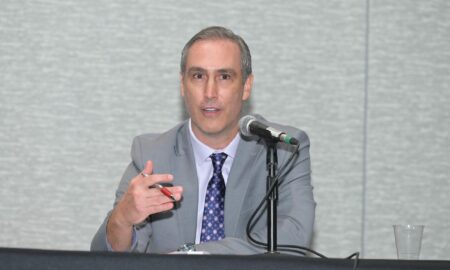





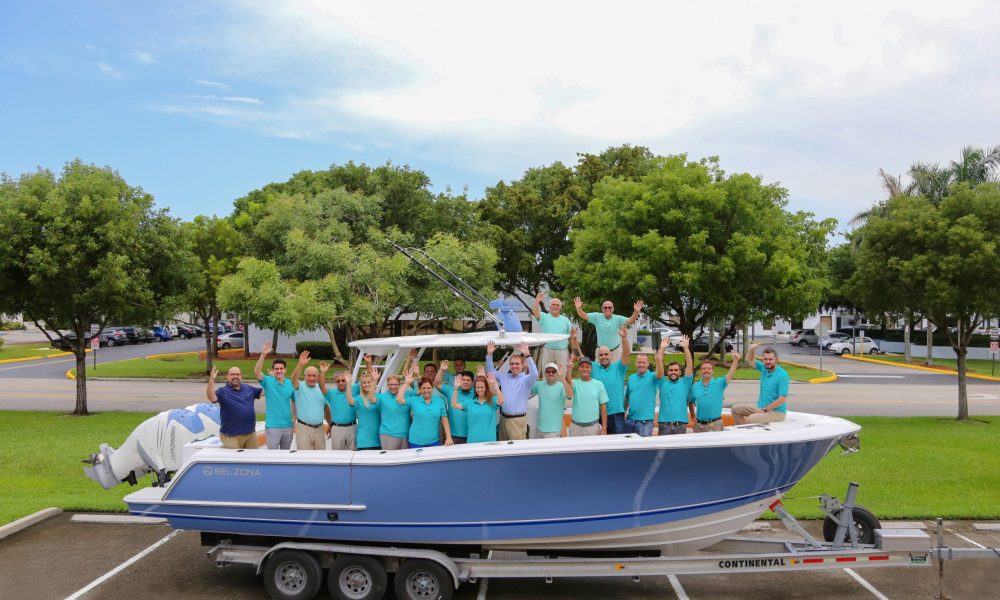
Today we’d like to introduce you to Joel Svendsen.
So, before we jump into specific questions about the business, why don’t you give us some details about you and your story.
Since childhood, I was always very intrigued by computers, technology, and engineering.
After studying electrical engineering at the University of Miami, that blossomed into starting one of the first dial-up internet service providers, shadow.net.
At the time, people were using a very early version of the internet, one only available to universities and government research facilities. In the very beginning, you weren’t technically allowed to offer this service to the public. We had to pretend we were providing it as a public service, for “research purposes.”
When the dot.com bubble burst, we decided to get out of that business. We merged with a company called Earthlink in 2003. I then had the opportunity to buy into the family business, Belzona, which makes industrial coatings and composite repair materials.
At the time, we had a distribution center in Miami coupled with our factory in England. But soon we’d decide to open a factory in Miami to complement our overseas production. We purchased a factory in Miami Lakes, and soon realized that we had more space than we needed for the chemical business.
I’ve always been very close to the boating world, the marine world. I’m a big scuba diver, spent lots of time on boats from the beginning of my life. And of course, a boat is an engineering exercise, so it seemed like a possible opportunity to get into the boating business.
Things were bad at the time in the boating industry—this was shortly after coming off the financial crisis of 2007—and I thought, “this is a great time to get in while all the suppliers are scrambling for new business and partnerships, and it would be a great time to hire good people.” So we ran an ad for a boat designer, and we got a bunch of great resumes. That confirmed that it was a good time to get into the business.
We’re always bombarded by how great it is to pursue your passion, etc – but we’ve spoken with enough people to know that it’s not always easy. Overall, would you say things have been easy for you?
Every business I’ve been involved in, I’ve gotten involved with because I’ve seen an opportunity to make that business better, to do something new. While the boating industry was a natural fit for South Florida, bringing the improvements I wanted to see in boats to life meant getting past a few hurdles, starting with engineering a better boat.
The big shift in the boating industry was the popularization of the four-stroke outboard.
The problem with outboards is that you compromise your transom’s swim platform. It really bothered me as a diver. I wanted an outboard boat, because they’re overall so much better—ease of maintenance, ease of replacement, they run better in shallow water, and offer better speed—but it was a pain as a diver to have to get on and off the boat from the back near the engines.
To add to that, my wife correctly said, “I don’t want the kids playing and boarding the boat near the engines, I’d prefer them to be away from that.” So, I was interested in designing a boat with a great side door—and not something small you could squeeze through, something that could be opened so wide that it would feel like having a diving platform on the side of the boat.
We looked a few possibilities, but decided the best way to get a big opening and a nice, flat surface was to get the door to slide aft. Next came getting through the engineering challenges to make it work. We tried a couple of common sliding mechanisms for the marine world, but we were getting too much friction. We wanted the door to roll easily, so we wound up sourcing an airspace solution from a company out in California, and that gave us a great solution we use to this day.
So let’s switch gears a bit and go into the Belzona Boats story. Tell us more about the business.
We look at the way people really use boats and design our boats around the way they’re really used. By contrast, you can design a product based on the way it’s bought.
The perfect example in the boating world is a cabin—you take a boat to a boat show, and it could have a big, beautiful cabin with all these features, and a tiny amount of deck space. At a boat show, that sells: you walk into a convention center, people see the boat and say, “My God, this is so beautiful.”
But if you go out to Biscayne Bay and you see people hanging out on their boats, they’re all outside, not in the cabin. So why design a boat that sacrifices so much for the sake of a sprawling cabin? It might help you sell the boat, but it doesn’t lead you to a customer that’s satisfied in the long run.
I’d rather design a boat the way the customer’s going to be happy. Have the customer buy it, over time come to appreciate it, and say, “this is really designed the way I use it.”
Over time, hopefully, that creates a lifelong appreciation from and relationship with that customer.
Has luck played a meaningful role in your life and business?
I’m not a big believer in luck. There’s an old saying in the boating world: “carrying sufficient life jackets prevents the boat from sinking.”
That’s as close as I’ll get to calling it karma—when you do things properly, you don’t have problems. When you take shortcuts, when you go for the quick and lazy way, that bites you. So, I think you really make your own luck in life and business.
Contact Info:
- Address: 2000 NW 88 Ct, Doral, FL 33172
- Website: www.belzonamarine.com
- Phone: 305-512-3200
- Email: [email protected]
- Instagram: https://www.instagram.com/belzonaboats/
- Facebook: https://www.facebook.com/BelzonaBoats/
- Twitter: https://twitter.com/BelzonaBoats


Getting in touch: VoyageMIA is built on recommendations from the community; it’s how we uncover hidden gems, so if you know someone who deserves recognition please let us know here.