




Today we’d like to introduce you to Jason Kokotoff.
Jason, please share your story with us. How did you get to where you are today?
I actually started my career as a photojournalist, which is what I went to school for at the University of Central Florida. I was the photo editor for the campus newspaper there.
After graduating in 2001, my career consisted of mostly working for small newspapers and freelance jobs, my love was sports photography. I was able to shoot NFL, NBA, MLB and NCAA events in Florida but, if I really wanted to make a lucrative career out of it, I knew I would have to travel to wherever the work was and I came to the realization that constant travel is not something I want in my life.
So, I switched gears to real estate photography and some freelance digital design in Orlando. The work was steady but nowhere near as interesting. I kept toying with the idea to move on to something new and then the real estate bubble made my decision for me. Once all the real estate work dried up and my wife and I had our daughter, we decided to move back to South Florida where all of our family resides.
I decided to get into web design and worked some temp jobs but I was having trouble getting something solid. Then my father told me about a new company that his boss, Edgar Otto, was starting that involved hyperbaric chambers for animals. I had always known about Mr. Otto’s affinity for animals, as I had done some freelance photography work for him over the years. But when I heard “hyperbaric chambers for animals,” I couldn’t help but be intrigued. He needed a new marketing coordinator and I decided to apply for the job. I had very little experience in marketing but I figured, I could get by with my creative talents until I caught on and Mr. Otto had always liked the work I had done for him so, he gave me a shot.
Mr. Otto is an extremely interesting individual, his father was one of the founding members of NASCAR and he himself was responsible for the TV dinner tray used by Stouffer’s. He was also involved with a very large human hyperbaric company, National Healing, which is where he got the idea to engineer a chamber exclusively for animals.
HVM was in business under 2 years, when I interviewed for a Marketing Coordinator position in 2013. When I came on board, HVM had a very small presence online and a branding that really did not fit the veterinary industry. This was perfect for me because I could make an immediate impact. I rebranded the entire company with new logos, marketing materials and a completely fresh website. I also made sure we had a presence across all the major social media platforms. And, as I went along I started to make the necessary contacts with those in the industry to try and convey exactly what HBOT (Hyperbaric Oxygen Therapy) is and how it works. Eventually, I was made Marketing Manager and in 2016, VP of Operations.
I have to say it’s been the most rewarding experience of my professional career to be part of something from the ground level that was virtually non-existent in the industry and watch it evolve and flourish to what it is now and the unlimited potential it has to grow.
We’re always bombarded by how great it is to pursue your passion, etc – but we’ve spoken with enough people to know that it’s not always easy. Overall, would you say things have been easy for you?
It has absolutely been challenging, since this is a new field and we are really the first company to engineer and place veterinary hyperbaric chambers on a global scale, we are also the first ones who get to make mistakes. And, we have learned from them every step of the way. Our “Partnership Program” has evolved over the years to make it easier for even small, independent veterinary facilities to install a chamber. Instead of a lease format, we simply provide the equipment and the training and the practice provides the staff and the patients. We then split the treatment revenue, which is about 65%-35% in favor of the veterinary practice.
We are now on our 3rd version of the hyperbaric chamber and will keep improving it with every iteration. We’re constantly listening to veterinarians and technicians who use the chamber and try to add on features that will make the treatment process more seamless. And, we are excelling at the shipment and placement of the chambers as well. These are no easy items to ship, weighing about 1250 lbs. but we have overcome those obstacles and now have provisions in place to install chambers with as little struggle as possible.
We’ve learned how to get the most “bang for our buck” at the trade shows, which can cost upwards of $20K per show if your’re not careful. And, we pretty much know what kind of advertising does and does not work for our type of product and service. In the beginning, we’d get all kinds of solicitations from ad companies only to find out that they really had no semblance of how to market our product due it’s unique quality.
So, as you know, we’re impressed with Hyperbaric Veterinary Medicine – tell our readers more, for example what you’re most proud of as a company and what sets you apart from others.
Like most people who don’t know anything at all about hyperbaric medicine, the first thing I thought of, when applying for this job was Michael Jackson and I still get that reference when talking to people today. Now that I’m educated in the field, I understand the frustration with the prevalence of that reference.
Still to this day, “how it works,” remains the most essential key to the success of our company. The science is actually more important than the chambers themselves. HBOT is really a quite pure and simple technology. The air we breathe is composed of about 78% nitrogen, 21% oxygen and 1% other gases like carbon dioxide. In the hyperbaric chamber 100% pure oxygen fills the capsule. But that in itself does not constitute a form of medicine. It’s only when the 100% oxygen is pressurized to 1.5 atmospheres or higher, that it is actually classified as a drug. That is when the pressure is able to diffuse the oxygen into the body fluids like blood plasma, which can carry the oxygen deep into damaged tissue 3 to 4 times farther than hemoglobin alone. And that’s where the healing begins. The chamber has literally saved the lives of countless animals from euthanization.
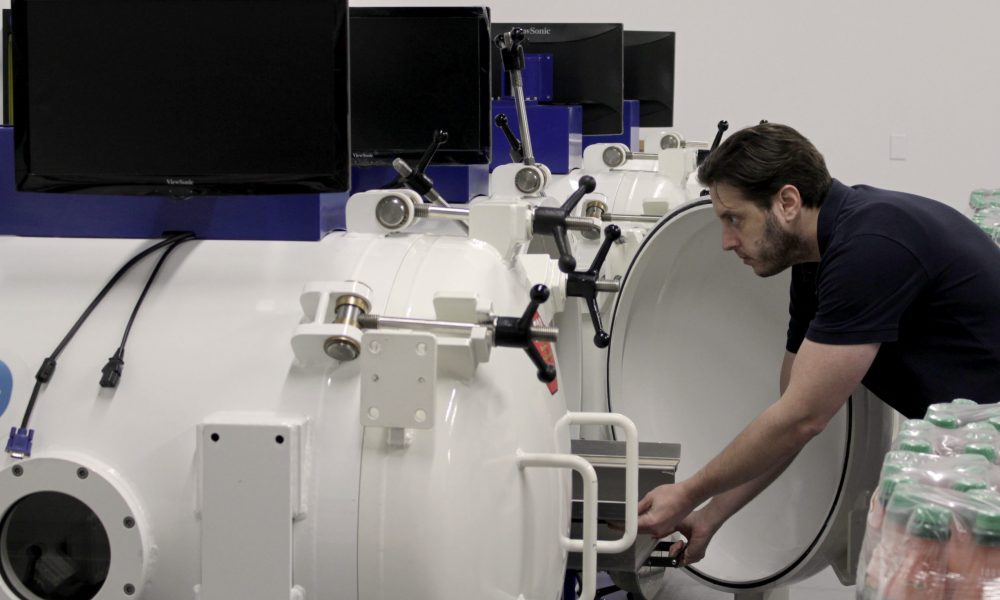
What makes our pressure vessels unique is that they are the first ones engineered only with animals in mind. They do not look like the clear human chambers everyone has as the default image of a hyperbaric chamber in their mind. Our chambers are not made of clear, acrylic plastic because that would be a poor choice of material when dealing with patients who have claws and are easily distracted. HVM chambers are made of steel and glass and are the safest animal chambers on the market, not just in construction, but in operation as well.
When I started in 2013, HVM had 8 chambers placed in veterinary facilities, mostly in Florida. We now have 44 locations including 3 major universities (UF, LSU, Auburn) and 3 international chambers in Canada, the UK and New Zealand. As veterinarians realize the simplicity and effectiveness of HBOT, they are starting to understand how to incorporate the treatment into their practices and how it can work as either a primary or complimentary form of medicine.
So, what’s next? Any big plans?
We are about to introduce our 3rd version of the veterinary hyperbaric chamber this year called the H1, which is a complete redesign from our previous 2 models and will incorporate even more precise oxygen monitoring capabilities and enhanced safety features.
HVM plans to continue educating veterinarians and technicians on the valuable benefits of HBOT and partner with even more institutions of learning so that students can be exposed to just how useful a hyperbaric chamber can be in a veterinary facility and so that they know how safe it is to operate one as well.
We’ll continue to work with organizations like the VHMS (Veterinary Hyperbaric Medicine Society) to maintain standards for treatment protocols and operator safety and training, and push more veterinarians and technicians to acquire their CHT-V (Certified Hyperbaric Technologist-Veterinary) certification.
Mostly, we want to seek out those veterinarians who are already excited about HBOT and are just looking for a way to offer it in their hospital. One of our main challenges is actually convincing people that they can have this chamber in their hospital at no cost. They usually do not believe us right away, it takes some convincing that we will place the chamber for free and simply share in the profits, while their patients gain the most important benefit… healing.
Contact Info:
- Address: 6400 Congress Ave.
Suite 1700
Boca Raton, FL 33487 - Website: www.hvmed.com
- Phone: 800-928-6886
- Email: [email protected]
- Instagram: https://www.instagram.com/hvmpets/
- Facebook: https://www.facebook.com/hvmpets
- Twitter: https://twitter.com/HVMPETS
- Other: https://www.youtube.com/user/HyperbaricVeterinary/


Getting in touch: VoyageMIA is built on recommendations from the community; it’s how we uncover hidden gems, so if you know someone who deserves recognition please let us know here.