


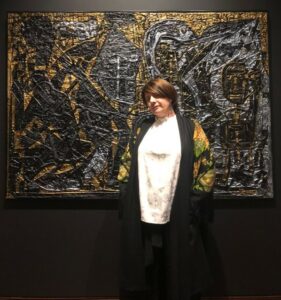
Today we’d like to introduce you to Ekaterina Khromin.
Hi Ekaterina, thanks for sharing your story with us. To start, maybe you can tell our readers some of your backstory.
I grew up in Saint Petersburg in a well-resourced soviet family. My father was an architect and mother was an architecture instructor at the Institute, though in truth, I was raised by my nanny, a working-class woman with a strong Russian Orthodox background. She was the kind that celebrated all the Orthodox holidays and polished door handles before Easter. I did not really understand the significance of my mother’s Jewish background until I was 16 when it was time to receive my passport. My mother told me to write “Russian” in the document in order to protect me from potential repression. My nanny’s Orthodoxy and very Russian cultural heritage were formative for me. Though I did not identify myself as Jewish, I felt an unarticulated kinship to my Jewish classmates and always stood up for them. At the same time, I saw a fully Russian girl when looking in the mirror.
My years at the Imperial Academy of Art were formative for me, the twists that left imprints on my fate still revibrate today and are found in the patterns of my artwork. I had a lot of friends at the time who were frequent protestors at the City Hall. They would go up there with posters, risking to be put on the watch list by the Soviet secret service. They protested the Israel immigration ban, which prevented Soviet citizens of Jewish ethnicity to return to Israel. They protested the imprisonment of Brodsky, who migrated to the United States to escape political prosecution, they protested for freedom of expression in art. I never protested. But I was still watched.
In the 80s my late husband, Victor, and I lived a fairly comfortable life, we had a nice apartment, a car. I worked as a children’s books illustrator and an illustrator at the Soviet Composer, a sheet music publisher. Illustrating music was a way for me to visually work with abstraction. We were immersed in the creative life of Leningrad, met with art collectors, exhibited our works at unofficial galleries abroad, spent long hours around kitchen tables in discussion, drinking tea, trying to piece together the scraps of information that made it through the Iron Curtain. Though on the surface our life seemed easy, there was fear and threat that lurked underneath the accepted social reality. There was a constant awareness that were all being watched.
In the time leading up to our departure for America, we had an incident that grounded our fears once again in the stark reality of the crumbling but still very much active violent ideological censorship of the late 80’s Soviet state. One evening someone rang the door, the man introduced himself as a neighbor, we did not know some of our neighbors as well so we were inclined to believe him. The man told us that the phone line in our section of the apartment building was not working and a maintenance person was to come through and check our phone line. We replied that our phone is in perfect working order, but that didn’t seem to matter. The next day a repairman came to work on our phone on the first floor of the apartment. Victor’s brother was visiting and the three of us were on the second floor discussing our travel plans. I needed to step out of the kitchen for something and as I turned the corner, I saw the supposed repairman, standing glued to the wall, his body rigid, listening in on our conversation. I screamed and drew back startled, terrified, but simultaneously recognizing the unspoken reality of the situation, the knowledge that we all lived with. The double reality of our existence merged into one in that moment without much contradiction Victor and I left the Soviet Union to exhibit a show at the Nachamkin Gallery in New York City. We had an invitation from the art dealer who was our host in the States. The exhibit was supposed to be up for two months, and we planned to stay for its duration and see New York, America, the New World. But two weeks later, the Gallery closed and everything seemingly fell apart. We ended up staying at my friend’s small studio apartment in Washington Heights, a neighborhood of New York that had a substantial Russian population. After we recovered from the initial blow, the cultural shock took in and sent us into a very different experiential space. The first months in America, we were riding a euphoric wave, from the stark cultural contrast, from the freedom, from the access, from all the abundance that the West had to offer. We could not get enough of our time visiting museums, galleries filled with decades of modern art which we previously had not been able to access.
Would you say it’s been a smooth road, and if not what are some of the biggest challenges you’ve faced along the way?
Back in the Soviet Union, we did not have any access to anything that was happening in the Western contemporary art world. The sparce information that did make it through was altered, and we only had torn bits of the narrative. I distinctly remember Victor had a black and white reproduction, postcard size, of Jackson Pollock. I would study it, knowing that there was a whole deeply complex reality somewhere behind the censorship, across the borders. There were artists, just like us, working in their studios, free to exhibit things that we had to hide between the walls of our apartments. When I would visit the Artist Union library, I could only request some of the early works of Chagall or German Expressionists and knew that all my library activities were surveilled. The cultural shock of moving to the United States was deeply wrapped up into my identity as an artist, as a woman of the soviet time. In New York, I would often go to Whitney and Metropolitan Museum and stand for hours in front of Pollocks or Rothko, completely deconstructing my previous consciousness, my previous self. This process continued for decades.
Encountering this new American freedom, I began to question whether I had the right to be an artist. I felt that I was so behind the art world, the heights that visual artists reached here in the United States, with the freedom of expression that was allowed them completely overwhelmed me. Though the constraints of the Soviet regime made us who we were, but who were we here? This was the question. The dialectic of my former reality no longer held me. My sense of self had no pillars left. It was May, my birthday, I was sitting under the supports of George Washington bridge that spans the Hudson River. Under the bridge, rubble, dirt, old grass, boards, rocks, the rubble was touching on a sense of nostalgia deep at the bottom of my being. I wanted to retreat into something wild, not the literal natural wilderness, but the wilderness of the soul, a kind of an unexplored space of the deeper reaches of my consciousness. And this bit of urban wasteland under the bridge felt just like the place for such an introspection. I was looking at all the broken remnants, junk scattered on the riverbank when I had the idea of taking molds of these forsaken and lost objects. This was my way of deciphering the code of the new world, and I would cypher it back into my work. I started to take objects that were around me, material shards of the new world, and arrange them together into new textures that contained the imprint of my storytelling. It is very difficult to be on new land without roots, it is very difficult to lose roots. The loss comes with grief, and what is lost is forever missed, there is never fully a letting go.
I was there, under this bridge, in the quiet, alone with the waves of the Hudson River. The uncut grass and May flowers stood in contrast to the homeless shanties in the distance and something reminded me of Russia, the decay, the dirt between missing sections of a sidewalk, the hum of urban activity contrasting with the black streaks of the rain-stained concrete. And yet, this moment was a gift for me from the universe, an inspiration, a spark that cut through the loss and melancholy. One of the more ephemeral struggles of a creative individual is that artists need someone who believes in their vision, something that has not yet materialized, something that is but a hope, a hazy dream.
Thanks for sharing that. So, maybe next you can tell us a bit more about your work?
As an émigré artist, I had to begin from an empty palette. I lost my circle, my network, the community that I had in Saint Petersburg. And I felt as if I lost myself, which threw me into a deep personal existential isolation. My New York friends at the time were more concerned with their families, children and the day-to-day. And the existential questions that plagued me had no outlet, no reflection. I was alone in trying to find some sense of belonging, and I had to do it in a way that encompassed me as an artist, a part of me that could not be cast of.
I had to seek some way of self-reflection, and since I couldn’t find it in people around me, I turned to my art process to seek out the deeper answers. I could not speak the same artistic language once I moved. The tension that compelled artists to make work in the Soviet Union made no sense here. I could not be inspired by the struggle under censorship and the oppression of the state. I had to find myself again through my work. And only by listening attentively to the smallest stirrings of the soul and being truly honest with myself and my emotions, I started to find my path again.
In my search for a new artistic language Synergism was born. Synergism was a new art process that combined collage, molds of objects, painting and relief. It allowed me to put myself back together piece by piece. I felt that I had to catch up with history, that I was frozen in time within the Soviet censorship. My task was to join the two histories together to bring harmony to my personal artistic vision. This way Synergism was born. The craft behind my work came from many years of art conservation and the vision was the symbolic recollection of my life as an immigrant and art historian. Synergism is not only a unique method of producing the art object itself but also a metaphor which allowed me to pull through many downfalls in my own life. It helped me restart my life in a new country and survive the loss of my husband.
The method of Synergism has been in development for over thirty years. It is an involved, multi-step process which produces an equally saturated work, a marker of my Russian tradition. Synergism is a fusion of painting, bas-relief, assemblage and conservation methods. Each series starts with a theme, most recently isolation and devastation of COVID. In each theme, I look for objects which relate to it. I gather objects from garbage heaps and antique auctions alike. My works contain imprints of signed baseball gloves, 18th century household items, old shoes, gloves, and more recently medical implements. First a negative collage is assembled from these objects, each placed with great intent, the idea is to concentrate most information per square inch of work to mesmerize the viewer. Then a mold is poured and from the mold each piece is made, it is then placed on a restoration vacuum table and fixed. Later the synergist object is painted in layers which develop greater depth, composition and movement. Each step requires meticulous attention, each material — great care of application.
There is a point in life at which you enter an unknown, an equivalent to the deep dark forest of Russian folk tales or an inner wilderness that I was seeking in my early years in New York. This journey can be especially palpable in an artist’s life, though all of us may at some point face it. It is here that we may find that we are in a conversation with an unknown substance. The substance that some may call intuition, emotions, a knowing, a spiritual entity, but it is something unseen. It is something without a singular term attached to it. And through this encounter within the dark forest of your experience, you reach a point, a sense that you are not alone. What keeps an artist going is being in deep integrity with each emotion that arises from this conversation. My work is the materialization of these emotions, the visions that come from the unknown. This brings an artist to encounter another struggle, the balance of daily life. You still want to be a good mother, a good partner, a good friend but those things cannot stand in the way of the call of your vision. There has to be a way to do both. Perhaps through the process of my work, I find that the universe is open and you can ask for what you need.
Do you have recommendations for books, apps, blogs, etc?
Favorite books, apps or podcasts I’ve been really inspired by the biography of Penelope Fitzgerald, who began writing when she was 58. I just finished reading her novel The Beginning of Spring which is set in Moscow and it impressed me in its authenticity, though the writer only spent a brief time in Russia. Also, I have been reading the biography of Louise Nevelson and also watched a documentary about her. I have also been reading a lot of materials on Reubens and Van Dyck, though this is more for work rather than leisure.
Pricing:
- Masks of Transformation Heat pressured medium, sculpted surface, metallic paint, canvas $90,000
- Remembrance in Red Heat pressured medium, sculpted surface, metallic paint, canvas Price $95,000
- The Unifying Web Heat pressured medium, sculpted surface, metallic paint, canvas Price 85,000
Contact Info:
- Email: kkhromin@gmail.com
- Website: http://ekaterinakhromin.com/
- Instagram: @katerinakhromin