





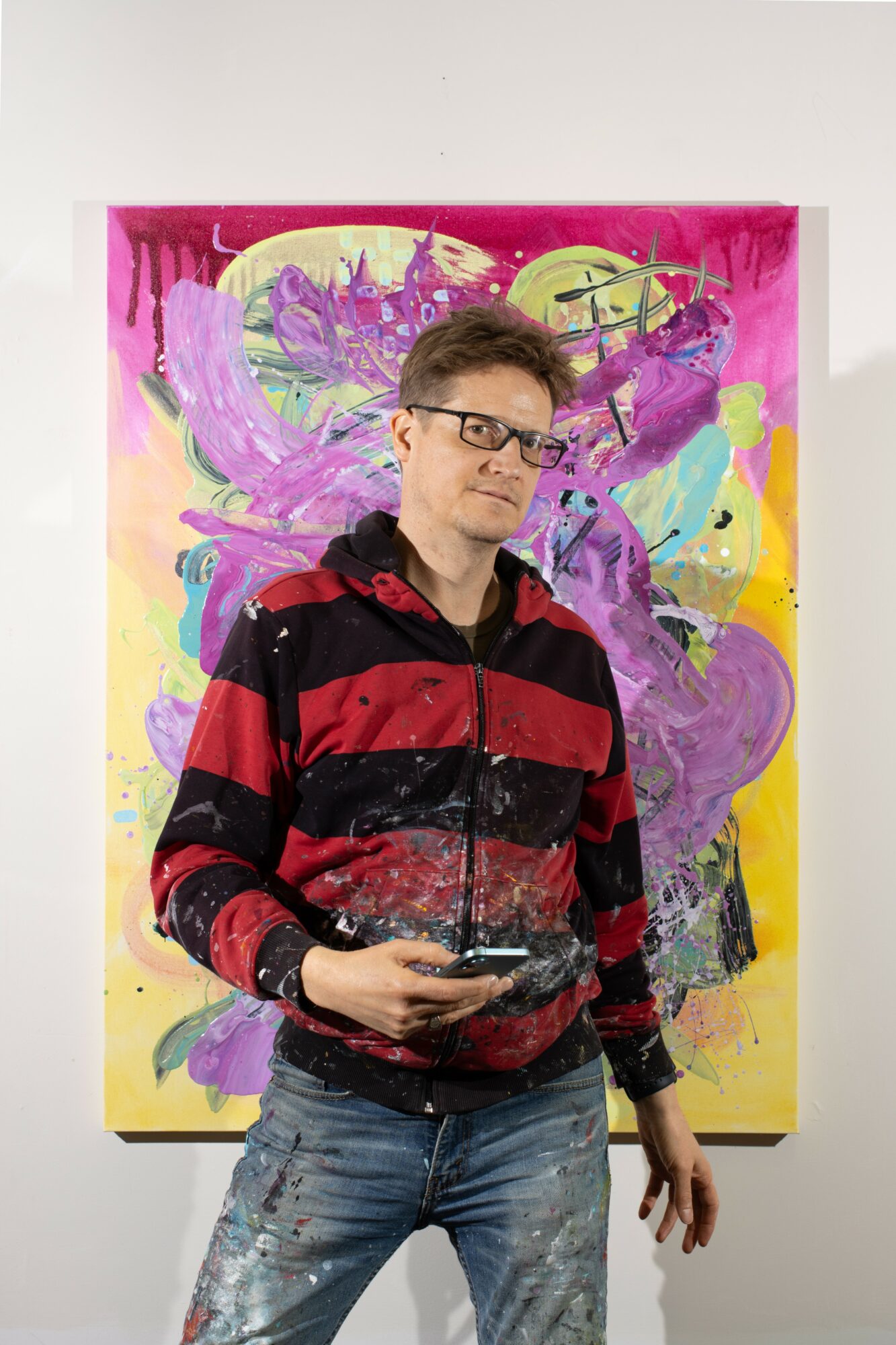
Today we’d like to introduce you to Blake Brasher.
Hi Blake, so excited to have you on the platform. So before we get into questions about your work-life, maybe you can bring our readers up to speed on your story and how you got to where you are today?
I was born in Oklahoma. My dad enlisted in the Air Force right out of high school and served for 20 years, so I grew up in Alaska, Arizona, and Turkey (with a year in Texas) before moving to Massachusetts to go to MIT when I was 18. Those different environments really influenced my perspective of the world, our place in it, and who we are. Alaska is such a vast wilderness filled with such intensity it’s difficult to describe, but one of my most powerful memories is of standing all alone watching the northern lights dance across the sky while waiting for the bus to school in the morning in weather so cold the liquid crystal screen on the calculator in my backpack froze and cracked. Turkey in the early 90’s was littered with astonishing thousand year old ruins scattered across the countryside in places with nothing around for miles and no other tourists to be seen. It was a powerful lesson in history and how things can be built up and collapsed and be built up and collapse again. How structures can be reclaimed and repurposed. How humans can reshape the landscape and then disappear. Arizona was like a sun blasted colony on Mars. Everything manmade in the Phoenix area feels like was just built and as soon as you get past the latest developments it’s nothing but flat desert as far as you can see. From a distance Phoenix looks like it has a dome over it at night, with the purple smog lit up by the urban lights.
I was always a bright kid and everyone always told me I was so creative. I did well in math and science and I always liked to paint. I always kind of wanted to do everything, except the “wet” sciences like chemistry and biology. I never had much of an aptitude or interest in them. Too much like spelling. I was never good at that either (thank goodness for spellcheck). I got ahead of my peers in math class and took Calculus my sophomore year of high school, acing the AP test with the highest score. At the same time I was taking as many art classes as I could and between Junior and Senior Year of High School I attended a pre-college Art Program at Carnegie Mellon University in Pittsburgh. It was my first time spending any appreciable amount of time in an Eastern American City (we’d once drive from Fairbanks to New York on our way to Turkey), and also my first time meeting adults who made their livings as Artists. Before that, I kind of associated “artist” with “history.” The program was basically Art School Jr. and we did classes in oil painting, figure drawing, conceptual art, even metal sculpture. There were nude models. There was real turpentine. We stretched our own canvases. I loved it and it made me want to be an artist.
I ran out of math classes at my Peoria, AZ High School and the administration didn’t know what to do with me. I proposed independent study Visual Arts and, having no better plan, the school gave me free rein of the art classroom for one period a day to build up a portfolio for the AP Visual Arts test. I didn’t do great, I got a three out of five, but looking back I literally had zero instruction that year so I think that was actually pretty good. Also that same year me and two other students were doing AP Physics BC, on our own in back room of the physics classroom.
I did extracurriculars like Thespians, directing one play, acting in others, but mostly doing set work. I was president of the Science club. We tried to form a debate team. I got in early to MIT and it had always felt like the place I was supposed to go so I accepted. It was the only school I applied to.
My AP scores earned me credits for some of the Core MIT curriculum classes like first term physics and first and second term calculus, so I cross registered at Harvard for painting classes my freshman and sophomore years. MIT is not only a pretty good school, but it is also a pretty smart school, and they don’t let their undergrads declare a major until their sophomore year. I probably would have declared physics if I’d had the chance going in. I love physics, and I was good at it. I got the highest scores possible on both AP Physics AB and AP Physics BC. But I am glad I got the perspective of my summer at CMU, my year of independent study AP Studio art, and a year of painting with Harvard students in a big beautiful studio at the Carpenter Center, the only le Corbusier structure in North America before I had to make that choice. The thing about Physics is that it is mind altering and it almost fills that place in the human psyche that religion takes up a lot of the time, but at a certain level Physics stops giving you broad answers and things get narrower and narrower. For me, painting started to be more of a guiding light. I felt like more of the answers I sought were behind my eyelids and the work I needed to do was to get them out.
I graduated from MIT with a Bachelor of Science in Art and Design (BSAD). Naturally, I got hired as a robotics technician at Boston Dynamics shortly thereafter. I had a lot of student debt. I lived in shitty apartments for years with several housemates. It was fun, we were young and we had a lot of parties. I had make-shift studios in the basements and would always have something going. At a certain point a good friend of mine had an apartment in the art-collective building Amanda Palmer lived in (Amanda and I dated for a spell during undergrad) and I sub-let her space to use as a studio. I moved into a co-op in Cambridge owned by a bunch of MIT alumni and took a second room to use as a studio. Eventually I got a sublet of half a space in an Artist’s studio building in Somerville, but got kicked out a year later for being there too much. My partner and I were moving to Lowell, anyway, so she could go to grad school at UMASS Lowell and I got my own studio at the Gates Block Studios building in downtown Lowell and we moved into an apartment a ten minute walk away.
Having a space to work has always been very important to me. I’m still in the Gates Block building, though I’ve moved studios a couple times to get a bigger space. Now I have one of the biggest studios.
At Boston Dynamics I was a technician for a couple years. We built the BigDog robot, which was a groundbreaking robot that could walk across very rough terrain and had an astonishing ability to recover from trips and shoves. I got promoted to Engineer. The BigDog project was a resounding success. I quit my job in 2008 to pursue a career as an artist.
Over the next couple years I worked on finding my artistic voice. I’d been trained at Harvard as a figurative oil painter, working off of live models and making paintings that had a clear narrative quality to them depicting human figures in suggestive environments. I’d always done little abstracts as color studies and warm up exercises and gradually these became more and more interesting to me. A friend prompted me to try to make a “real” abstract painting and so I took the leap. I’d always liked looking at abstract paintings and was super interested in them, but had always felt like an artist needed permission in some way to be able to work in abstraction. It’s like, you need to prove you can paint a convincing figure before you can just two paint around. I don’t really believe this on an intellectual level, but it felt like a very real barrier. I was a competent figure painter, but I wasn’t getting any joy out of it anymore. The real good stuff felt like it was on another level. So, I just went for it.
Making abstract paintings turns out to be hard. With a figurative painting you kind of know when you’ve done a good job because the thing looks like the thing it’s supposed to look like. In abstract painting, the whole game is just about evoking feeling, and feelings are hard to nail down. I spent a while trying all sorts of ways of composing an abstract painting, and at one point some patient mentors of mine told me they wished I’d choose a style and stick with it for more than one or two paintings.
Layering is an important part of my work. I remember once going to a very trendy perfume shop in New York City with my fiancee and her sister. It was one of these sorts of spots where you had to know it was there, not a lot of signage, and we were the only ones in this space that was about the size of a large walk in closet. I was taken in by the interior design, a sort of shabby-fab aesthetic with peeling paint and old wallpaper torn away in spots to reveal wood grain and other rich patterns. The space felt like it had such a deep history, I had to ask what it had been used for previously. The clerk just said, oh that’s all fake, they just put all that on the walls to make it look old. I had been totally taken. I loved it. Now it is a strategy I employ in my work. I am not trying to make the paintings seem old, but I do try to create layered compositions where there are spaces that don’t come fully to the surface, where something like an obstructed pattern makes the viewer fill in what must be going on inside the painting. My work is often colorful and somewhat maximalist, but the real magic in the implication of what is happening in the spaces you cannot see.
I think we humans, specifically we modern humans living in the 21st century, are very verbal creatures. We tend to think that we think in words and that the thinker of words is who we are. Abstract painting is so powerful because it denies this assertion. An abstract painting can inspire feelings in the viewer that do not have words associated with them. It’s a phenomenon we are all familiar with in music. Nobody listens to a classical concerto and demands to know what it’s supposed to be. Abstract painting is the time domain analog to the frequency domain solution provided by music to the problem of cognitive expression that transcends language.
I had no idea what I was doing after I had quit Boston Dynamics. In retrospect, I wasted my time trying to figure out ways to sustain myself financially. I had worked as a living statue after I met Amanda and started doing that again, painting myself all white and dressing in an angel costume with giant wings, standing perfectly still in Harvard Square until someone gave me a tip, at which point I’d give them a little bow. I had a few other art-adjacent ventures I started up with mixed success, but it turned out the living statue and the painting were the only things that were ever really profitable. I was starting to have some success selling paintings, but the money ran out after a couple years. It ran out after one year, if I’m being honest, but I had good credit and so I used it. Eventually it became obvious I was going to have to go back to work.
I reached out to Boston Dynamics in 2010 and asked if I could come back part time. They said yes. I was able to pay my bills and still be in the studio three or four days a week. I’d learned what it took to maintain a studio practice, and if anything I became more prodigious in my output after going back to work. The studio time was more precious, and I could afford the materials.
My work continued to develop, and I started getting invited to artist residency programs. I did a number of residencies between 2011 and 2020, mostly just two week long programs because I did still need to show up at work. My first program was in the mountains of rural Romania, Garana, near Timisoara. That’s when I learned I could paint on the floor instead of on an easel, and this meant you could let gravity do all kinds of work for you. It was because the shared studio only had so many easels. I did a handful of international residencies and a couple domestic ones over the next few years. My last one was a second residency at Studios at MASS MoCA in late 2019.
I’ll do more, later, but the thing was that we were expecting a baby in early 2020! I was freaking out a little bit and I signed up for grad school. I wanted to get into an MFA program because I was worried that being a new dad was going to eat my life and I wanted to have an external motivator keeping me in the studio.
Our first boy was born in February of 2020. I started my MFA program that January at Lesley University in Cambridge, MA.
We moved into a proper house in Harvard, MA. The place came with a finished basement, which turned out to be a godsend because when CoViD hit it meant I could set up both a studio down there and an office / lab space for my day job. I spent a lot of time with the baby strapped to my chest in a Baby Bjorn pacing around 56” x 56” canvases down there, slapping paint down and pushing pours. I had three months of paternity leave during that first bit of the Pandemic where it just felt like it was us in the woods and I didn’t have to worry about anything outside of the house except for my MFA program.
I met a lot of great people in the program, and maybe most importantly an artist there who was a member at the Bromfield Gallery in Boston recommended that I look into joining. I’d always had a lot of respect for Bromfield Gallery. Bromfield and Kingston are the top two coop galleries in Boston.
Art galleries in Boston are almost all in this part of the city called SoWa, for South of Washington St. Truly, most are in this complex I call the Gallery Strip Mall at 450 Harrison Ave. That’s where Kingston, Bromfield, and Chase Young Gallery are. Chase Young Gallery is a commercial gallery, and it has always been my favorite. Something about the quality of the artwork there, plus the vibes in the space have always made me feel like that was where my work belonged.
I’m currently represented by Chase Young Gallery. It’s been a long journey. For a lot of artists, including myself, getting representation from a prestigious commercial gallery is like the top goal. That’s when you feel like you’ve made it. But, like anything, the reality is a bit more nuanced. I started my relationship with Chase Young Gallery more than ten years before I became represented by them. Anytime I was in the area I would make a point of going into the gallery. I made small talk at first. Eventually, Kate, the Gallery Director asked if I had a website and I stood there in horror as she loaded it up and we talked about some of the work. My studio was in Lowell, which kind of a long way away for a studio visit. But then when I got involved with Bromfield I would tell her about my solo shows and after my second one I was on a trip with our then four year old and she mentioned that she saw my show, she liked it, and the gallery was seeking another artist. Perfect timing for the four year old to start to have a meltdown. There was a prompt exit with promise to follow up and then actual follow up over email. I had to be rather persistent in this. As I’ve come to learn, it can be pretty difficult to get Kate to respond to an email, and it’s not that she is uninterested or doesn’t want to respond, she’s just very busy. Part of me always felt like maybe I should just give up, like she was just being nice, like not getting an answer right away was the same as a rejection, but I kept at it and eventually we scheduled a phone call, and then, a couple months after our conversation at the gallery, a studio visit.
Kate came to my studio. I did my best to clean it without making it look too clean. I made sure there were places to sit. I provided some fancy donuts from the Korean Donut shop next door. She liked the donuts, and she liked my work. We started working together shortly thereafter. I had to leave Bromfield Gallery, which was sad because I really liked the other artists there, but they were all very happy for me, and I was frankly glad to not have to go to meetings and gallery sit anymore. I had to give up a fair bit, actually. I used to do a ton of group shows in the Boston area, though organizations like Cambridge Art Association or other local galleries. Now I can’t do any of that. Chase Young Gallery has exclusive rights to show my work on the entire east coast of the US outside of New York City (which is its own thing). I had to shut down my online storefronts and stop selling work directly from my studio. It seems like a lot, but I’ve been hustling in the art world long enough to know you only get so far as an “outsider.” I want to be on the inside, and I want my work to be taken seriously by curators, critics, and other artists.
To be honest, it’s kind of great not being able to participate in all those local group shows. I don’t miss the hustle, and it’s helped me refocus my energy on the work itself and on finding and applying for better opportunities. I’m currently focused on working with more museums and universities, and on forging relationships with commercial galleries in other regions. It means I’m getting a much higher ratio of rejection letters that I had become accustomed to, and can be really difficult to deal with, but I feel a sense of momentum in my career and that feels great.
We had a second child in 2023, and in 2026 conditions at Boston Dynamics became such that for some reason I could no longer continue as a salaried part time employee and so now I go in five days a week. It is tough. My goal is to get up at 4:30 Tuesdays and Thursdays, when my partner handles the morning routine, and get to the studio for a couple hours before work. I get afternoons on Saturdays sometimes too. It is rough, but I feel like I’m doing the best work of my life. Chase Young Gallery has already sold over $36k worth of my paintings this year. (I get half that) I figure if I can get representation at three or four more galleries I might be able to give up the day job.
As far as day jobs go, I do feel pretty lucky. I mean, I’m a designer on the R&D team for the worlds most advanced humanoid robot. It’s pretty fucking cool. It’s just that the answers I seek are buried in layers of paint, and I want to uncover every wrong answer to the question of why we are here and what are we doing.
Alright, so let’s dig a little deeper into the story – has it been an easy path overall and if not, what were the challenges you’ve had to overcome?
It’s been incredibly challenging. From my perspective, there are only three ways to make it as an artist.
1. you can be born into a rich family that supports you no matter what you do and have the resources available to you to flounder for the years or decades it takes for an artist to find their voice and actually start producing work that anyone will care about.
2. you can be very lucky, go to Yale, and get picked up by a top gallery at your thesis exhibit
3. you can do what I did, and just hustle for decades finding any way possible to spend time in your studio while still making enough money to pay the bills.
In truth, I was also very lucky. I have a brain that has always made math and science very easy for me and went to MIT despite being born into a family where neither of my parents had gone to college. It was amazing going to MIT and meeting all these incredible students who were my peers and finally getting the sense of just being average if not, even sometimes, a bit below! It was also difficult to navigate the fact that while many of my peers didn’t have to worry about how much they spent on food and didn’t need to have a job during the semester, I did. I had to turn down invitations to fancy restaurants because I could not afford the bill. I worked the 2am – 6am shift at the campus Coffeehouse in the student center. I worked at the library. I got a gig as a paid research assistant at the Media Lab.
After I graduated and had been working at Boston Dynamics for a few years, I managed to save up what I thought might be enough of a nest egg to launch my artistic career. This was in 2008, and the economy was falling apart. Friends warned me not to abandon a lucrative career in this environment, but I just felt so much like I needed to give it my all or I would never forgive myself. In 2008 I turned 30 and ran through my savings faster than I thought was possible. I made it until 2010, but by then I’d blown through the savings and racked up a ton of debt. Thankfully, when I called up Boston Dynamics, they took me back in and were even willing to let me work just two days a week. It felt a little bit like coming home with my tail between my legs, but also like actually I had this amazing community that was willing to bend the rules to let me figure out how to make things work the way I wanted. The thing I learned in my two years as a full time artist is that it takes a very long time to make it as an artist, and the thing that I learned when I came back to Boston Dynamics was that you can make things work the way you want, but it will never happen if you don’t ask.
These days, as a father of two young boys and a full time engineer I have to get up at 4:30am on days my fiancee is taking care of the morning routine (Tuesdays and Thursdays) so I can get to the studio for a couple hours before work. I’d love to be in the studio every day but the finances just don’t work out.
Artistically, it took me a long time to realize “Artist” was a viable career option. I didn’t know anyone who knew anyone who was an artist growing up. There was also a lot of pressure for me to do something math and science related.
I had some real hangups about going abstract. Even though I always loved looking at abstract paintings there was always this little voice telling me there was a part of it I just wasn’t getting. Like there was some kind of decoder ring you could use to make abstract art “make sense.” Well, it turns out, for me that decoder ring is just making the stuff yourself. It’s just about how it makes you feel.
Alright, so let’s switch gears a bit and talk business. What should we know about your work?
The work is about projecting an inner, private, mental space onto the canvas. It’s an attempt to capture ideas and emotions and the chaos that bubbles just below the surface of conscious thought. I’m interested in our non-verbal intelligence. We have a sort of linguistic operating system running in our brains and we tend to think that our thoughts happen in words and sentences but that’s not the core of who we are. So my work is engaging in a feedback loop between my visual cortex and whatever is going on in the painting. I try to amplify the things that feel right and push back the things that feel wrong. I pepper the work with visual prompts to build off of and I try my best to just let it happen and not think too hard about it.
The experience of looking at my paintings is like getting sucked into an alternate reality. My layered compositions hint at things that are obscured but in a way still present. This opens up an extra sense of depth in the work, it’s like the viewer can go inside the painting and find little resting places. There are things to explore and places to hide and things you only see after you’ve looked at the painting a hundred times.
I am known for making large, colorful, chaotic paintings. I’ve been showing in the Boston area for nearly two decades and have built a community of fellow artists through participating in organizations such as the Cambridge Art Association, Bromfield and Kingston coop galleries, and a series of international and domestic artist residency programs. My work has historically been included in a wide variety of curated group shows in the Boston area and across the US. I’ve also had a number of solo shows at a variety of venues ranging from restaurants in Cambridge to a medieval cathedral in Transylvania to commercial and cooperative galleries. My paintings can be found installed in several corporate spaces in the Boston area, especially a 40’ long painting installed in a tech office in Kendall Sq. Cambridge.
I work all the time, as much as I can, whenever I can. I don’t wait for inspiration or deadlines. I make a lot of paintings. When I was just starting out I heard some statistic that successful painters tend to make about 50 paintings a year, so I set that as a goal and I’ve basically been doing that many paintings or more every year since 2008. It’s almost a problem. I work faster than I document, so many paintings never get photographed, or the photos I take sit unedited in my Lightroom catalog for years. I have a huge inventory of stretched canvases taking up a pretty sizable chunk of my studio space, and at times it can feel like the walls are closing in. But I keep working. Even if I feel like I don’t have any ideas or I feel like the work is in a difficult place and bad paintings are happening I just work through it.
I got representation at Chase Young Gallery almost two years ago, and it was because I was persistent and I went into that gallery so many times and I had so many little conversations. I had two solo shows while I was at Bromfield Gallery, and I made a point of going around to a handful of commercial galleries I respected in the area whenever I had work up to let them know and ask if they’d find time to walk over and take a look. Kate at Chase Young Gallery visited my second solo show at Bromfield, and I saw her at Chase Young Gallery the following week to follow up and that was the moment that set everything into motion. She had seen the show, she liked the work, and she wanted to see more.
I’m most proud of my gallery relationship with Chase Young Gallery in Boston. I always loved the gallery, and I’ve been going in there to look at their shows for decades. I am proud of myself for maintaining that thread even when it felt like nothing was happening. In the end, it actually worked out!
I think a couple things set me apart from the others: I’m willing to doggedly pursue the things that I want, and I don’t mind when it’s hard or uncomfortable. Getting gallery representation is hard and awkward. The other thing is my parallel career as a robotics engineer. I’ve been involved in robotics pretty much since robotics became interesting. There are two parts of my intellectual journey, doing art and doing robots.
I’m an outlier in my approach to the art world. Instead of going to art school, getting an MFA straight after undergrad, and pursuing a teaching career, I went to MIT, got a job at Boston Dynamics—at the time a little company just starting to get into robotics—and didn’t get my MFA until I was in my 40s. Now I am a Senior Staff Electrical Engineer on the humanoid research and development team. My path has been to work as an engineer and do my best to negotiate for time to work in my studio. I’ve never had any sort of financial cushion to fall back on, so it has been and still is a necessity for me to keep a day job. Perhaps that will change as my art career continues to grow, but for now I am grateful that if I need to have a day job, at least I’ve ended up with a pretty cool one and I get to be surrounded by good smart people every day I go to work.
Is there anything else you’d like to share with our readers?
I’d love for readers to visit my web site at www.blakebrasher.org, and while they are there they can leave comments and sign up for my newsletter. I’m also on Instagram @electroblake and always appreciate a follow! Thank you for this opportunity, I hope my responses have not been too long!
Contact Info:
- Website: https://www.blakebrasher.org
- Instagram: https://www.instagram.com/electroblake/