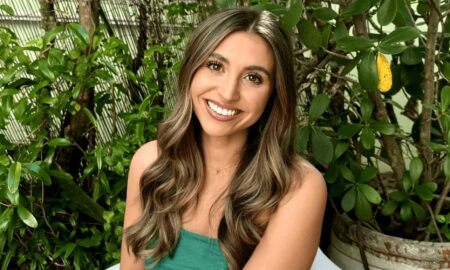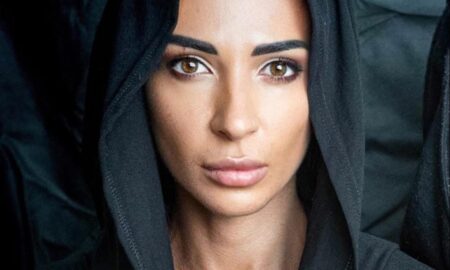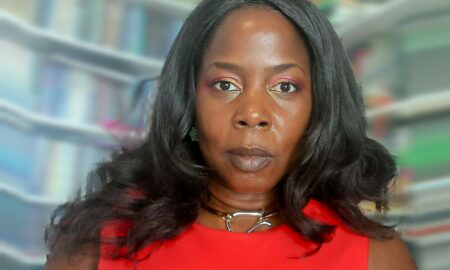


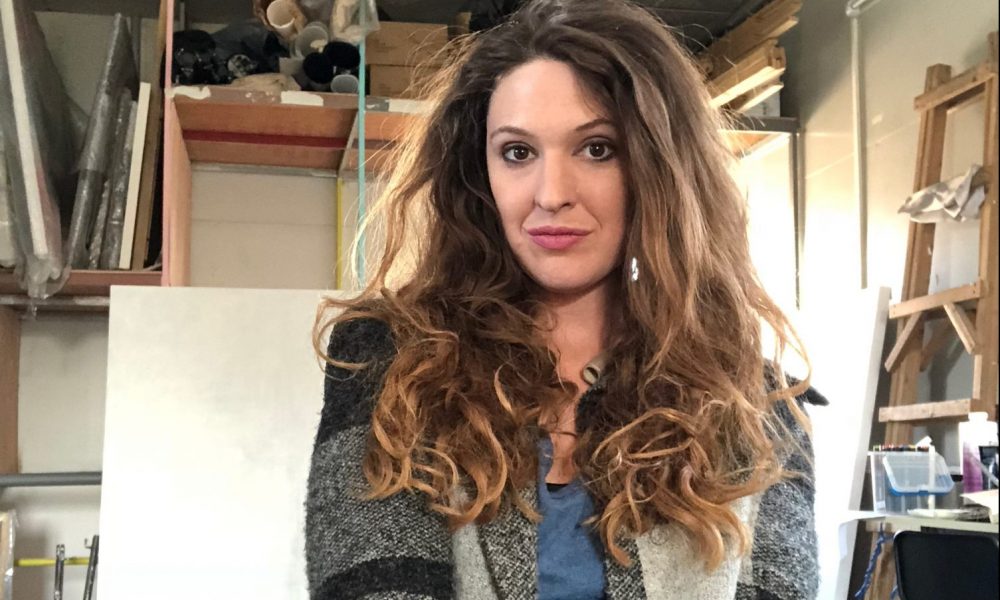
Today we’d like to introduce you to Natalya Kochak.
Every artist has a unique story. Can you briefly walk us through yours?
I was born in Yonkers, New York and have since lived in many different places in the United States, from Alabama to Kansas. From Texas to Florida. I graduated with my BFA and my MFA from The School of the Art Institute of Chicago and now live in Miami, FL. My arts studio is located in Little Havana.
In 2010, I received a residency with the Red Gate Gallery in Beijing and in 2011 traveled to Berlin for a three-month residency with Takt Kunstprojektraum. I also received a Kickstarter grant to teach art in Uganda for two months. While there I worked on my own projects and created a community mural with my students. I recently just returned from my second artist in residency in China at The Lido Art Center in Guangzhou, where I also had a solo show. I plan to return to the residency in a year to start a new project with the support of the gallery and art center. Directly after that residency I returned to the United States and did an artist residency in The Smokey Mountains in Georgia at The Hambidge Art Center.
As a child, I began to embark on a journey that I did not understand yet. My mother is a journalist, which always gave me an innate appreciation for curiosity and striving to learn those things I did not know. I learned that there are not always easy answers and sometimes asking those questions can lead to even more questions. Sometimes they can lead to discomfort and awkwardness, but the importance is in asking the questions.
When I was young I did not understand America’s race issue. I did not understand America’s patriarchal system, but as I grew I did begin to notice the divide. I began my existence in New York. A place where it was hush, hush to ever acknowledge that anyone was racist, but the white community, all of whom were immigrants would quietly speak ill of those that were of a different color. I then moved to Kansas, a place that was dominated by religion and in that, divides were created by not only race, but class, and religious beliefs. I was beginning to learn that America, though it is the “land of the great”, was also inflicted by deep societal trauma’s that left many, including me, angry.
My senior year of highschool I moved to Alabama. Here is where the true recognition of the divide became apparent to me. Black and White classmates mixed in social settings, but were often separated by where they lived, as well as by their skin color. I often heard things that I would not want to repeat that a white classmate would say about a black classmate. At this time, I did not understand why.
As I grew to become an artist I began to realize that my love was painting and that my love was to paint those around me. Having lived in so many different types of places I realized that I did not want to seclude myself in a particular community, but I wanted to see the world. I wanted to learn about other cultures. My work became about culture. It became about community and intersectionality. I began to see the differences and the similarities and I wanted to explore this. I also became interested in analyzing photography, but to create paintings, videos, and other pieces.
Please tell us about your art.
Okay, so one of the first things your work is reminding me of is a quote I came across some years ago written by a fin de siècle black woman: “We are not a coming people. We are here.” – Mashadi Matabane
We Are Not a Coming People, We Are Here, the project I have been working on for two years, began organically: Two families, both with an interest in genealogy and history, started to look for something, not knowing exactly what that was, but looking for something. My mother, Jacqueline Kochak, a journalist and writer, a woman with a love and obsession for knowledge and truth through the exploration of history, set out on a search for her own family history not knowing what the result would be. Along the way, she began to speak with Paula Whatley. Paula, a woman who lived only one hour away from my mother, was on the same search. They were two Southern women who found each other. Their common connection was an ancestor, an ancestor who happened to be a slave master. This knowledge was extraordinarily hard for my mother to accept at first. She always thought she was from a poor farming family. Paula, on the other hand, knew of her family history and wanted to open a dialogue.
My interest deepened as I learned of the similarities between the four women involved, Paula and my mother, Paula’s daughter and me. My mother and Paula are only a couple of years apart in age, one a journalist and the other, a documentary filmmaker and professor. I found out that Mashadi, Paula’s daughter, was a writer and academic, and I am a contemporary artist. We are two sides of one coin, exemplars of a narrative that has been buried by controversy and a shame in American history that has yet to be fully acknowledged. The brutality of that time and the unacknowledged history is at the forefront of our continued conversation. The exploitation and the abuse of that period, continued through the 20th century has resulted in an anger and division that must be confronted.
I proposed that the two families begin to get to know each other through starting a conversation, and in the process, we could become a family, a family that has never been acknowledged. I proposed a project using our family archives, and to make reimagined images for our family. These first take the form of collages and montages of our two families’ images that are put into a manipulated book written by the confederate woman, Mary Chestnut’s diary. I am overlaying her writing with all 4 of our contemporary writings and that of the enslaved woman, Harriet Jacob’s memoir. The book is renamed, My Family’s Anti- Autobiography. From the collages I create large-scale paintings to synthesize these moments and write them into present history.
Paula and her daughter respond to everything I create. We have a continued skype conversation. I am collecting data, a new archive. A video piece is being made from this data. In doing this, we rotate agency. We are history making—chatting and acknowledging, collaborating and negotiating. Through a newfound unity, we are transcending a patriarchal society; shame is revised into a new beginning.
What do you think about conditions for artists today? Has life become easier or harder for artists in recent years? What can cities like ours do to encourage and help art and artists thrive?
I moved from Austin, Texas to Miami because of the funding that artists can receive in Florida. Texas offers very, very few grants or really anything to their residents. Florida does not offer nearly as much as states like NY or cities like Chicago or New York City, but I believe that things will change in Miami. The art scene is growing and more serious artists are moving here. It will take time, but I believe it could be an arts epicenter. The cultural and political landscape of Miami in particular is important and the many institutions in South Florida that artists can show their work is less inclusive and more attainable then other cities.
How or where can people see your work? How can people support your work?
Right now you can make an appointment with me at my studio to view the work and/or learn more. There will be many more opportunities to see it in the future and I will update those opportunities on my website and Instagram as they come.
Contact Info:
- Address: My artist’s studio:
1155 SW 6th St. - Website: www.natalyakochak.com
- Phone: 3129336626
- Email: nkochak@gmail.com
- Instagram: natalyakochak


 Image Credit:
Natalya Kochak
Getting in touch: VoyageMIA is built on recommendations from the community; it’s how we uncover hidden gems, so if you know someone who deserves recognition please let us know here.