


Today we’d like to introduce you to Joyonna Gamble-George.
Hi Joyonna, we’re thrilled to have a chance to learn your story today. So, before we get into specifics, maybe you can briefly walk us through how you got to where you are today?
I was born in Tampa, Florida. I grew up on the East Coast of the United States between the states of Florida, rural Alabama on my grandparents’ farm, and Maryland. Later moving to Greenbelt, Maryland in my early teens, I attended Greenbelt Middle School and Eleanor Roosevelt High School. I graduated from Eleanor Roosevelt High School – a recognized presidential school of excellence with merit from the school’s science and technology program. I earned a Bachelor of Science in Biochemistry and Biology with Cum Laude and Honors in Mathematics from Xavier University of Louisiana, a private Roman Catholic HBCU, a Master of Health Administration from the University of South Florida College of Public Health, and a Ph.D. in Neuroscience from Vanderbilt University.
I was raised by a family that truly believed in the importance for acquiring a quality education and giving back to one’s community. As a result of my upbringing and getting involved at an early age in programs that support the STEM disciplines, I developed a love and passion for science and technology. Volunteering with the Peace Corps and the University of South Florida to address health disparities in the state of Florida and overseas increased my passion for public health. For instance, I volunteered overseas in the Dominican Republic to build outhouses and provide health education workshops and free antiparasitic medication to village residents that encountered daily issues with sanitation and vaccine-preventable and vector-borne diseases. From this experience, I realized the importance of connecting patient-directed resources to medically underserved communities with the help of science and technology. These experiences that fueled my passion for public health, science, and technology led me to obtain graduate degrees in public health and neuroscience.
As a child, I either wanted to become a professional artist or medical illustrator, a physician, or a scientist. My grandmother and a summer research program helped me determine that becoming a scientist was a part of my destiny. My grandmother, Mrs. Menda Gamble Pettway, raised me on a farm in rural Alabama; she was a retired elementary school teacher and business owner of my grandparent’s grocery store called the Pettway’s Place for over 50 years. Grandma Menda was also a voting rights activist and a registered voter prior to the passage of the Voting Rights Act of 1965; she participated in numerous marches, including the Selma to Montgomery march, to help register African American voters without harassment and discrimination based on race. As a child, I remember going door to door with her to help homebound and socioeconomically disadvantaged African Americans exercise their constitutional right to vote. Grandma Menda’s activism taught me the importance of community service and how it can help an individual build character, find a new passion, and promote personal growth and a sense of accomplishment. Because of my Grandmother, I saw how scientific discovery could be seen as a form of humanitarianism, especially when it is used to save lives by creating cures for common diseases that affect people worldwide.
I completed a summer research program while I was a high school student that was sponsored by the National Aeronautics and Space Administration (NASA) and the Quality Education for Minorities (QEM) Network that helped me understand that becoming a scientist would be an interesting, worthwhile, and beneficial career. The science and engineering apprenticeship research program was known as SHARP PLUS, where I worked on a research study in the Department of Chemistry at Norfolk State University, studying the bonding structure of molybdenum (Mo) with amino acids. Molybdenum is a cofactor for enzymes that metabolize sulfur-containing amino acids and nitrogen-containing DNA and RNA bases (purines and pyrimidines) and can be found in vegetables, milk, and whole grains. I was trying to find how molybdenum’s involvement in the development of gout, a common form of inflammatory arthritis caused by a buildup of uric acid crystals in the body after ingestion of amino acids, could prevent the disease from spreading through augmentation of Mo-amino acid complexes. The described research opportunity helped me to solidify my belief that I wanted to become a scientist, especially while I was working in a research lab during my graduate studies at the University of South Florida College of Public Health. Working at a VA hospital, I conducted experiments with drugs that had been known to treat kidney cancer to see if they could treat memory problems in people with a common form of dementia like Alzheimer’s disease; that was my first opportunity to do research that concerned the human brain. After this opportunity, I was completely hooked on neuroscience research and two years later, I moved from Florida to Tennessee to complete a doctoral degree in neuroscience at Vanderbilt University to become the scientist I dreamed of. I knew I wanted to pursue STEM in my career when I acquired a love for studying how brain cells, called neurons, work as a neuroscientist. What excites me about these cells is that I get to discover as a scientist what happens to them when they malfunction and what I can do to fix them when they do not work properly. I find this exciting because it is similar to solving a puzzle with a lot of missing pieces and is quite challenging, especially since humankind does not know everything about the brain and how it functions. We are still learning about new processes and pathways that occur in the brain for use to carry on ordinary functions such as memorizing events, places, and people or preferring one thing over another. Likewise, as a scientist, I can use my mind and cool tools or machines to create treatments or technologies that can help people manage or cure their health conditions and even prevent them from getting a particular disease or disorder. Also, I get to inspire future generations of students, especially young girls and others that are historically underrepresented in STEM fields, to desire a career as a scientist and provide an example of all the STEM career possibilities they can achieve.
My crowning scientific achievement as a neuroscientist was attending the 64th Lindau Nobel Laureate (Physiology or Medicine) meeting in Lindau, Germany after being selected as one of 600 young researchers on a multi-step competitive basis from approximately 20,000 applicants worldwide to attend this meeting. I was the first African American woman selected to represent Vanderbilt University School of Medicine at this meeting. During this meeting, I had the opportunity to network and meet with Nobel Laureates to discuss future research approaches to medicine. The highlight of the meeting was talking to Dr. Elizabeth H. Blackburn, who won the 2009 Nobel Prize in Physiology or Medicine for her discovery of how telomeres protect chromosomes from being broken down. She told me and a few other young female researchers from a variety of ethnic and racial backgrounds that our selection to attend the meeting signified that we were “going to do extraordinary things” in science or medicine. Her encouraging words helped to see that I belonged in a STEM career even though many professionals in STEM did not look like me.
We all face challenges, but looking back would you describe it as a relatively smooth road?
I am the first one in my family to pursue an education and career in STEM. Most of my family members are working or have worked in other fields such as education, law, or administration. As a result, I did not have any role models in my family to guide me along my STEM journey. Also, as a woman of color, I have many times experienced being the “only one.” This has been the case when I majored in or worked as a scientist in a STEM discipline. The absence of Black/African American and female mentors, who worked in the biomedical sciences, was a tremendous challenge; often a concerned hand can make the difference in understanding an environment and give you clues regarding the invisible important work components. There is an apparent gap between male and female roles and a disparity of ethnic or racial minorities in STEM fields; I have endured social isolation and limited access to resources and opportunities that could help me advance my STEM career goals. There have been times when I did not receive proper scientific credit for work that I completed on research projects, and there have been not so subtle microaggressions. My experiences have been challenging since people at times did not accept me, even with my educational credentials, talent, and skills as a scientist, because they had assumptions and preconceived stereotypes about how they believe a scientist should look. That is why it is so very important to have and see representation of women, especially women of color, in STEM-related media and the workforce because it helps to dismantle the preconceived notions and ideas people may have of who is a scientist and their looks; seeing and working with examples of female excellence in STEM is vital.
When faced with a challenge, there seems to be this innate human inclination to just learn to avoid conflict and its potential repercussions. This practice often leads to mental and physical fatigue. When we do this, we cut ourselves off from the possibilities that await us to be amazed by. Rather than shut down completely from the challenging experiences like the ones I have endured, I tend to not dwell on them or let them deter me from my aspirations in life. I turn that negative energy into positive energy and continue to pursue my career path because I know who I am, I am proud of who I am, and I know I have what it takes to be a great scientist. There is a purpose for all parts of our STEM journey. When we worry about “why is this happening to me” and “why is this happening at this point in time,” it minimizes our ability to find the true meaning. For me, the reason was to keep pushing forward to be a living, breathing example of black female excellence in STEM. By doing so, I can contribute to STEM learning and work environments by enriching its diversity of thought and experience and making the future STEM communities representative of our diverse nation. Future generations that aspire to pursue a STEM education and career as a scientist will look to me one day for guidance and view me as a role model or potential mentor when they are facing similar adversity.
Thanks – so what else should our readers know about your work and what you’re currently focused on?
I am best known for my creativity, innovativeness, and skills as a scientist. I have over twenty years of experience discovering cures and treatments for the most common health diseases and disorders, such as cancer, Alzheimer’s disease, affective and drug use disorders, and HIV-associated neurocognitive disorder. I was trained as a neuroscientist at Vanderbilt University and behavioral scientist at New York University to study how emotions and decision-making processes work in the brains of animals and people to find ways to reduce anxiety, depression, and substance misuse in people. Currently, I am studying how interactions between an individual’s genes and their social environment contribute to substance misuse, mental health problems, and other health risk behaviors. As a scientist, I have traveled the globe sharing my research approaches to medicine with diverse audiences, including Nobel Prize winners. I have also served as an expert science advisor at the National Institutes of Health for doctors, psychologists, nurses, and other scientists all over the United States that conduct research on chronic heart and lung diseases and mental health in people living with HIV. In addition, I get to tell the public about my scientific discoveries in the form of art, illustrations, and graphics designs, written works published in scientific journals, or orally at meetings and seminars. This part of my job as a scientist I find quite rewarding since I get the opportunity to share my research findings with the rest of the world and then other scientists can use them to furthermore discoveries that can save lives by curing or preventing disease or other health conditions.
During my doctoral studies in neuroscience at Vanderbilt University, I became an entrepreneur and co-founded SciX, a biotech company searching for data science-based methods to combat brain disorders and other health issues. As a scientist at a biotech company, I directed the research behind and development of wearable devices aimed at improving chronic health conditions in patients. A typical day involved writing up experimental designs for future research projects and working with a team of technologists, software engineers, healthcare professionals, and other scientists to create a prototype of the devices we dream of creating. Later, I co-founded two additional companies, where I currently serve as the Chief Executive Officer, that allows me to combine my creative pursuits as an artist with STEM education. One company is called Solonna that offers consultations, customized art, illustrations, and graphic designs, and other artistic creations to enhance individuals’ personal and professional spaces and lifestyles. The other company is a STEAM (Science, Technology, Engineering, Arts, and Mathematics) education consulting and professional development business focused on closing opportunity gaps and removing obstacles for individuals, especially those historically underrepresented in STEM fields (e.g., people of color, girls and women, and people with disabilities or learning English as an additional language). It also provides public outreach efforts that emphasizes arts and creativity in education. My company collaborates with K-12 schools, community colleges, universities, nonprofits, and companies that champion education and professional development initiatives. My business acumen and advocacy for STEM-based entrepreneurship was honored with the 2018 Entrepreneur of the Year Award, as a finalist for the 2019 Lewis A. Shattuck Small Business Advocate of the Year Award by the National Small Business Association, and with the 2020 Tampa Bay Business Journal 40 Under 40 Award.
Besides being a scientist, artist, and entrepreneur, I am also a public health professional. I served as a health system specialist and evaluated the day-to-day functions of a Veterans Affairs medical center and performed strategic planning and implemented initiatives to improve customer service, veterans benefits, and patient hospital admissions. Moreover, I have implemented community-based initiatives in rural communities to combat infectious and chronic diseases due to my passion to promote public health in populations impacted by health disparities. My previous research and community outreach efforts in the public health field concerned assessing Florida’s trauma system to guide its future development and improve patient outcomes, quality management case studies, and examining the health needs and barriers to affordable and accessible healthcare in rural, medically underserved communities.
What matters most to you?
In 2019, I was chosen as one of 125 women from a variety of science, technology, engineering, and mathematics (STEM) careers to serve as high-profile role models for young girls and women through the American Association for the Advancement of Science (AAAS) IF/THEN® Ambassadors program. As an AAAS IF/THEN® Ambassador, I have shared my story about my STEM journey and the many ways in which I use STEM to solve societal problems and create new possibilities for the future. The IF/THEN® initiative was founded on the belief that “IF we support a woman in STEM, THEN she can change the world.” It is dedicated to closing the gender gap in STEM careers and inspiring the next generation of women STEM pioneers.
Through the IF/THEN® initiative, I am creating a culture shift that addresses gender biases, imbalances, and stereotypes in STEM in many different environments, such as in the media, at scientific meetings, in entertainment, in the classroom, at museums and parks, and in the workplace. I have worked to promote diversity in science as a panelist at the Wonder Women Tech virtual summit that spotlighted women in science, the Ai4 2020 meeting to discuss the importance of inclusion in technology, and for the Magnimind Academy webinar series to bring a diverse perspective on artificial intelligence in healthcare, a male-dominated field. I have as well discussed my STEM journey through various media outlets, including the “Geeky Girl Reality” blog and an e-learning platform linked to the Girl Scouts of the USA’s new STEM career exploration badges. Additionally, I have given virtual lectures to more than 560 students in 18 classrooms across eight US states on topics such as what a neuroscientist does for a living, the education and skills required to become a neuroscientist, the scientific method, and brain illness. My dedication to expanding students’ STEM career exposure and bringing real-world relevance to their education were rewarded with the Nepris Outstanding Volunteer Award and the Trailblazer Award. Through my volunteerism, I have helped to prepare students for the future of work in STEM.
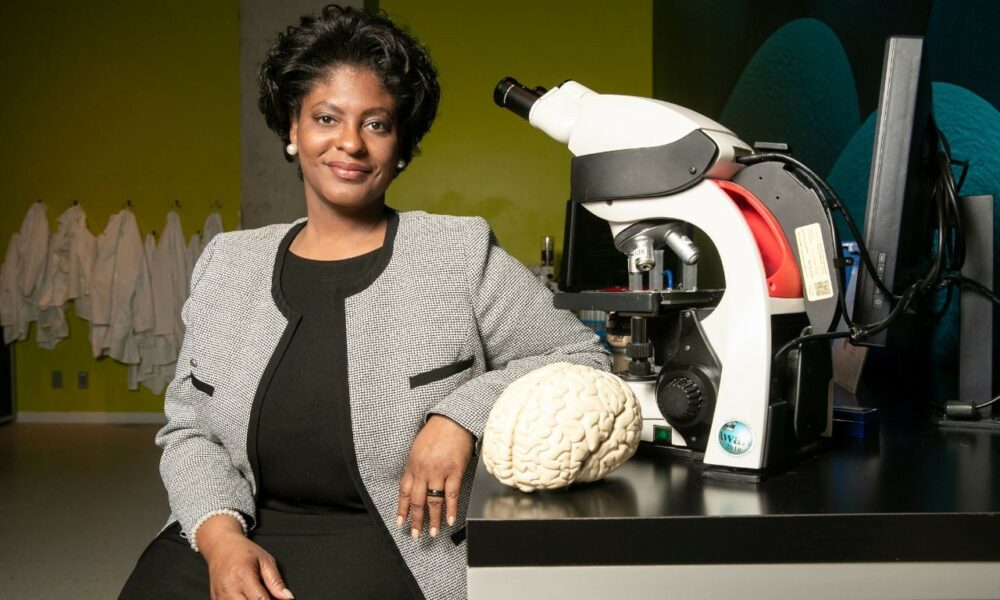
Furthermore, my life-size 3D statue showing me holding a human brain, which symbolizes my expertise as a neuroscientist, that was exhibited at Dallas Love Field Airport is another example of the IF/THEN® initiative in action. It was recently exhibited at a shopping center in Dallas, called NorthPark Center, and in Washington, D.C. at the Smithsonian as part of a larger statue exhibit of more than 100 AAAS IF/THEN® Ambassadors. There are less than six statues of real American women that exist outdoors in parks or downtown areas. The women exhibited in these statues are not currently living and cannot be contacted by aspiring STEM inventors or pioneers for advice or to describe their STEM journey. We can only find out about their career trajectory through history books and other forms of media. The IF/THEN® life-size 3D printed statue exhibit is essential for STEM pioneers like myself and for the public because it will allow me to provide a living, breathing example of the STEM career possibilities that young women and ethnic and racial minorities can achieve. I will be able to encourage the next generation of STEM pioneers to believe in and achieve these possibilities. If we support young women and people of color to pursue and succeed in STEM careers, then today’s research programs will benefit from diversity of thought and experience.
This ambassadorship allowed me to change the narrative that women and ethnic or racial minorities (black, indigenous, and people of color or BIPOC) are not changemakers and leaders in STEM fields. It is important to have and see representation of women, especially minority women, in STEM-related media and the workforce because it helps to dismantle the preconceived notions and ideas people may have of what they think a scientist looks like or what profession a woman would work, survive, thrive, and even succeed in. Having examples of female excellence in STEM is vital. Being a part of the IF/THEN® initiative will help me to make the future science community representative of our diverse nation. Moreover, being a woman in a field historically dominated by men, I believe that it is part of my obligation to act as a role model for students of both sexes. While it is important that women observe and support successful female colleagues, it is just as crucial men realize that women can equally contribute to these STEM professions. I relish the opportunity to create an environment for learning and teaching void of gender bias.
Contact Info:
- Email: info@joyonnagamble.com
- Website: https://www.joyonnagamble.com/
- Instagram: https://instagram.com/joyonnagamble
- Facebook: https://www.facebook.com/JoyonnaGamble/
- Twitter: https://twitter.com/JoyonnaGamble
- Other: https://en.wikipedia.org/wiki/Joyonna_Gamble-George


Image Credits
Courtesy of Dr. Joyonna Gamble-George and the Lyda Hill Philanthropies’ IF/THEN® Initiative