




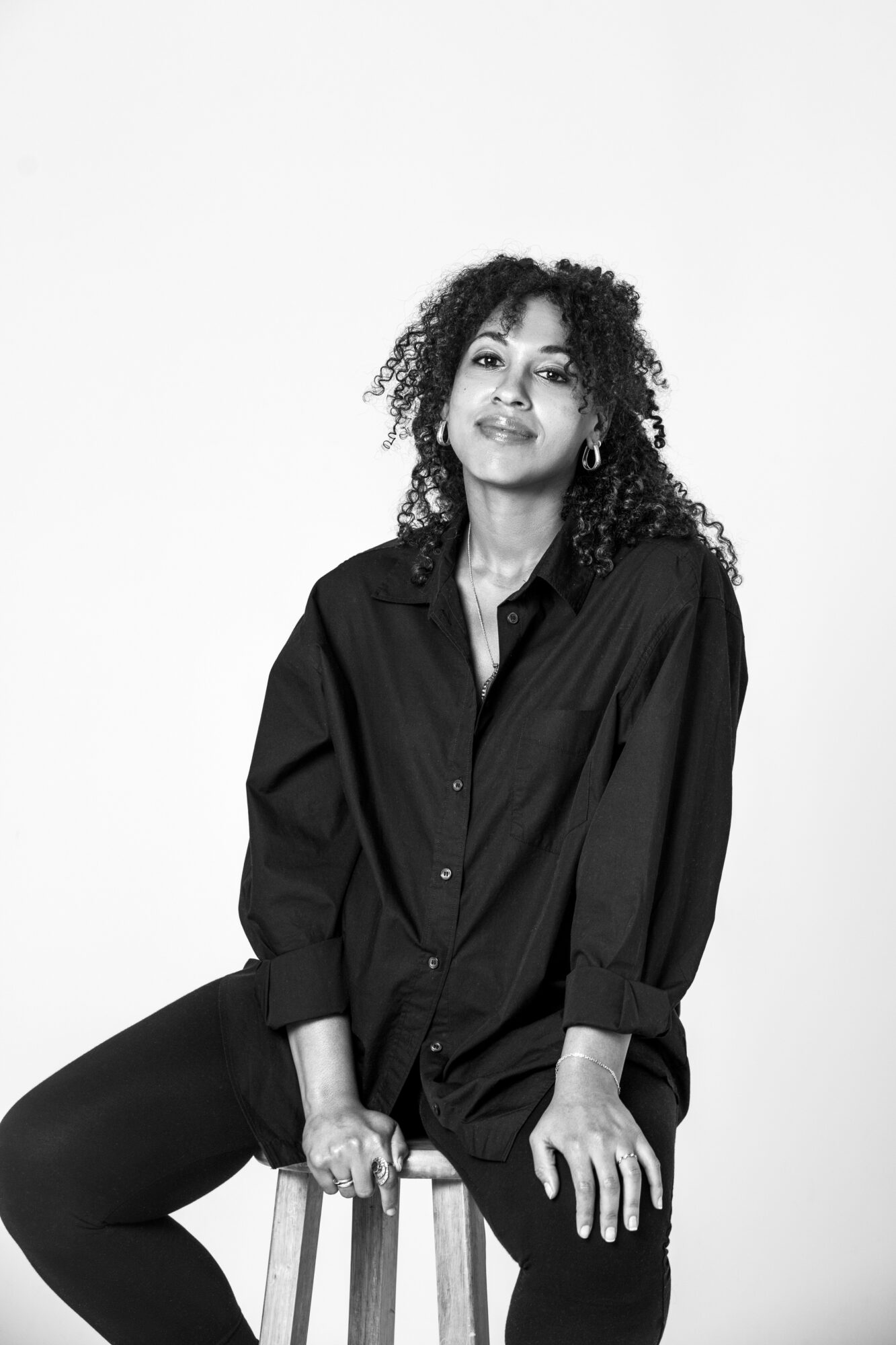
Today we’d like to introduce you to Liliane Laborde-Edozien.
Alright, so thank you so much for sharing your story and insight with our readers. To kick things off, can you tell us a bit about how you got started?
Before becoming a filmmaker, I first trained as a biologist. I made the switch into film by attending an unorthodox graduate training program in London that takes scientists and turns them into artists—filmmakers, writers, and gallery curators. While I had a background as a dancer and actor, it was really this program that kickstarted my career in film.
I shot my first film, Drummies, over two months in South Africa. Drummies follows a group of elementary school-aged drum majorettes as they navigate growing up in one of the world’s most dangerous areas—the Cape Flats, where drugs and gang violence are rampant. My second film, Saudade, follows three Baianos in Salvador, Brazil as they wrestle with saudade, a Portuguese word connoting a longing for what was or could have been. This more personal and poetic film was a deviation from the more traditional, linear structure of Drummies. Both films had small but successful festival runs and helped me discover my voice and visual language, a journey I suppose I’ll always be on.
I’m currently working on two short narrative films. The first is Matrescence—a fairytale about a new mother who, in the haze of postpartum depression, sees her baby as a strange doll… until a mystical encounter with a mysterious woman awakens her. The second is Queenie—a character profile on an aging but magnetic drag queen as she weaves her own self-grandizing mythology of her past and spreads neighborhood gossip to her young aspiring filmmaker neighbor. I am the director and writer for both projects.
Can you talk to us a bit about the challenges and lessons you’ve learned along the way. Looking back would you say it’s been easy or smooth in retrospect?
I’ve had a solid career as a producer working on big campaigns in the U.S., Europe, and Latin America for some big brands I love and admire. And I’ve had plenty of opportunities to prove myself as a creative in development, on set, and in post. But my path has been meandering and somewhat unconventional, especially coming from a hard science. Biology is deeply creative, but it isn’t a field people tend to associate with artistry. Because of this, it’s been a bit of a struggle to establish myself as a creative and not just a purely analytical, logical operator. People like to put you in a box—you can either stay trapped in it or use it as a frame for thinking beyond it. I chose the latter.
Another challenge has been finding community on the road. I’ve lived and worked in Africa, Europe, and South America, as well as LA and New York, before eventually putting down roots in the 305. My nomadic life has left me with a wealth of experiences I pull from creatively but it’s tough to keep building community from scratch, particularly in an industry that relies so much on being integrated into a scene. Miami has such a rich community of artists and I’m excited to be part of it.
Thanks for sharing that. So, maybe next you can tell us a bit more about your work?
I am first and foremost a storyweaver. I write and direct stories that explore concepts of transformation and the human condition through archetypal characters and narrative arcs. How can I accurately portray the particularities of this story or character while simultaneously illuminating the universality of their human experience? Whether it’s an emotional interview for a documentary or drawing out an authentic performance from an actor for a narrative work, this question informs my work and ultimately sets it apart.
How can you take a word like saudade, a Portuguese word that’s uniquely Brazilian and everywhere in Brazilian art, and make it relatable to people outside of Brazil without just calling it “nostalgia”? Well, who hasn’t looked at a night sky, mountain range, or horizon disappearing over the ocean and not felt a haunting yearning to be reunited with something they just can’t name? In Saudade, I try to show the viewer that saudade isn’t just uniquely Brazilian—it’s uniquely human. And that universal human uniqueness is at the heart of my work.
We’d love to hear about how you think about risk taking?
Creativity calls for risk taking. The muses make for demanding gods and often require you to sacrifice what you find most sacred. You pour your heart and soul into hundreds of pages only to scrap half of it, if you’re lucky. Or you spend weeks in an edit only to realize it just doesn’t work. One of my favorite writers, Mikhail Bulgakov, wrote then burned his masterpiece, The Master and Margarita, under threat of censorship by the Soviet Union. Then he wrote FOUR more versions before it was finally published. And the uncensored version didn’t even appear until decades after his death.
While my films have never been censored (although one of my photos once caused quite a stir at college for the crime of showing a naked human body), I pay attention to the desire to self-censor. If a creative decision scares me, I try to explore why that is. Fear of judgement? Or fear of judging my own creations? Or, most likely, the fear of losing control of the narrative. But creativity demands losing control to the process and having faith that it’ll work out. Some of my most interesting and authentic creative decisions have emerged from those leaps of faith.
Contact Info:
- Website: https://www.lilianelabordeedozien.com/
- Instagram: https://www.instagram.com/lilianefilms/
- LinkedIn: https://www.linkedin.com/in/lilianelabordeedozien



Image Credits
Liliane Laborde-Edozien