





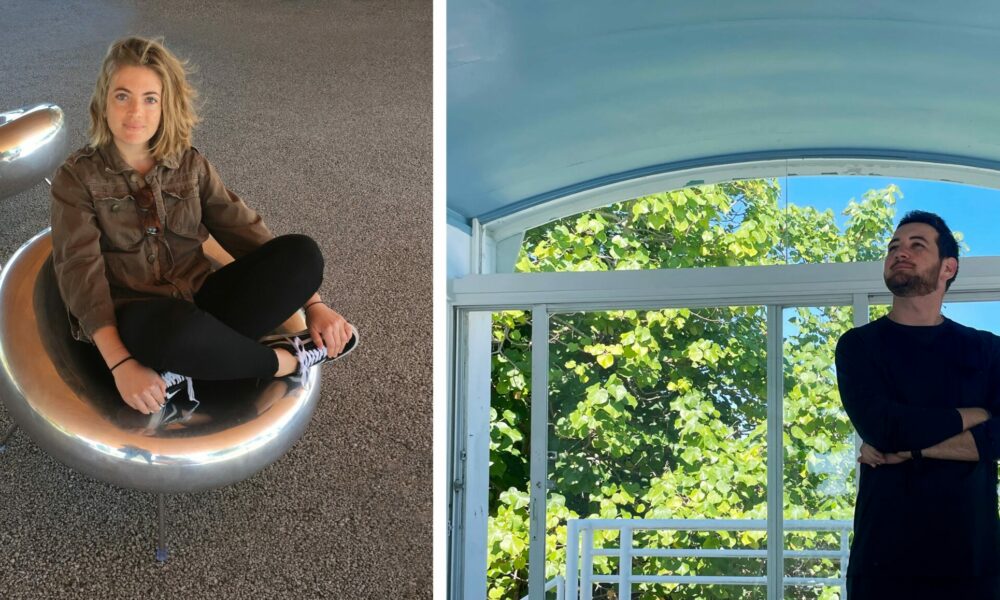
Today we’d like to introduce you to Josh Ehrlich and Mariella Tzakis.
Josh and Mariella, we appreciate you taking the time to share your story with us today. Where does your story begin?
I grew up in the small tropical paradise of Sarasota, FL: the home of the Sarasota School of Architecture, which, in many ways, has symbolized the center of the tropical architecture world.
My most precious childhood memory is spending afternoons working in my grandparents’ garden. From a young age, I was attracted to the tropical spirit of Florida and wanted to combine my interest in gardens, houses, and creativity.
After completing my studies at Columbia University, I obtained degrees in architecture and landscape architecture and traveled to Basel, Switzerland to apprentice with Herzog & de Meuron. The Swiss office is well known throughout Miami for building the Perez Art Museum, the 1111 Lincoln Road Parking Garage, and the Olympic stadium — the Bird’s Nest — in China.
While working in Switzerland, I was most inspired by the office’s creative approach to designing buildings in far-away places. We began every project with an intensive study of the place, culture, and climate. Unlike most architectural firms, the office does not really have an apparent architectural style but rather works like “archeologists”, attempting to uncover and reveal the special and unique characteristics of the places in which they built each new building.
I believe that PAMM embodies this philosophy perfectly — it is one of the most “Miami” and most tropical buildings in the city — uniquely appropriate for the climate and inspired by the native flora. It’s almost like the building wasn’t “designed”, but is rather a precise and careful response to the local conditions. The massive canopy roof, hanging gardens, and elevated terraces are all answers to the unique qualities and challenges of Miami. It has been a tremendous learning opportunity to be involved with that project and the office.
I believe that all architecture in Miami, and particularly houses, should be inspired by similar, fundamental qualities: creating shade, integrating with, and celebrating the amazing tropical nature, and respecting sea level rise and hurricanes… This way one can simultaneously create something perfectly appropriate for this magical city, but also something that stands out by nature of its extreme specificity to the region and city.
Can you talk to us a bit about the challenges and lessons you’ve learned along the way. Looking back would you say it’s been easy or smooth in retrospect?
During my education and apprenticeship, one of the biggest struggles was being separated from the climate, nature, and spirit of Florida.
I was lucky enough to live, study, and work in cities around the world — Portugal, Brazil, Zurich, Italy — but I always dreamed of returning to open my own architectural office in Florida. In 2019, Miami presented me with the opportunity to return, and I took it eagerly.
That year, I met my partner Mariella Tzakis, and we were fortunate to be introduced to an incredible, large family who was planning to build a shared family compound in Miami. It was with this multi-structure project that we began to build our office, TROPICA, and continued to develop the ideas that have fascinated us since childhood. We will be forever grateful to this family who gave us our first opportunity to express our talents. Our office has since continued to grow; we are currently working on about twelve buildings and gardens, some of which I have shared here.
Great, so let’s talk business. Can you tell our readers more about what you do and what you think sets you apart from others?
What I feel sets us apart is our fantasy and desire to tell a story with every new building.
We believe that fantasy is the single most important quality for an architect to have in their creative work, and in the tropics, there is no shortage of inspiration.
With every new project, we attempt to tell a story for the owners — a narrative that they can believe in that guides the project and that speaks to them while also responding to the climate, site, and surroundings.
At PAMM, the narrative of the architecture is so strong that the office was able to convince the clients of a scheme that is almost contradictory. Typically, museums are large, air-conditioned boxes, set in dense cities, turned inward, focusing attention on the interior. The Perez completely flips this classical idea of a museum inside out — the most amazing space of the building is actually the exterior, elevated, and shaded plaza, protected by the hanging gardens that seem to hover over the bayfront. This terrace is almost like a European square, where everyone can gather and enjoy the surroundings, regardless of if they purchased a museum ticket. This narrative, created by the architecture, allows for many kinds of experiences and interactions on this platform, which is unlike any other space in the city.
In our current projects, we are especially interested in taking inspiration from ancient narratives that represent repeated historical motifs. In this way, the smallest project we have right now may also be the most interesting: a small pool house that sits in a beautiful garden. We were interested in garden tents from history and myth which were routinely depicted as the most fundamental architecture to enjoy a garden. Similar to a tent, the pool house’s curving roof is held in tension, like a fabric, between the living room and kitchen. We found this narrative to be particularly appropriate for this project — it might be something completely different for our next building.
Is there something surprising that you feel even people who know you might not know about?
We are very proud of the projects that we have designed to date and are excited to continue to push the limits of what it means to create a “tropical” architecture.
The idea of “Tropical Modernism” as a style of architecture is thrown around a lot, but we feel the houses here often fall short of what it means to be truly “tropical”.
There is a unique energy and spirit in Miami that is characterized by vibrant colors, lush nature, and a festive culture. I hope that our work somehow speaks to these unique qualities of Miami and excites and enlivens those who visit and live within our projects.
Going forward, one of our main goals is to further express our interests in the combination of architecture and landscape architecture. We hope to integrate lush gardens with the houses we create. The perfect project would be to design a house that is like an inhabited garden — inside one would experience the walk through the rooms as if they were strolling through, or living within, a continuous garden. Each room would have windows to unique types of gardens and the architecture of the house would create a new, parallel world for the inhabitants: an edible paradise, full of fruit trees and tropical plants, like some of the images I have shared here.
We are excited to express the unique qualities of Miami in our work — that is TROPICA.
Contact Info:
- Email: josh@tropica.miami
- Website: www.tropica.miami
- Instagram: @T_R_O_P_I_C_A