





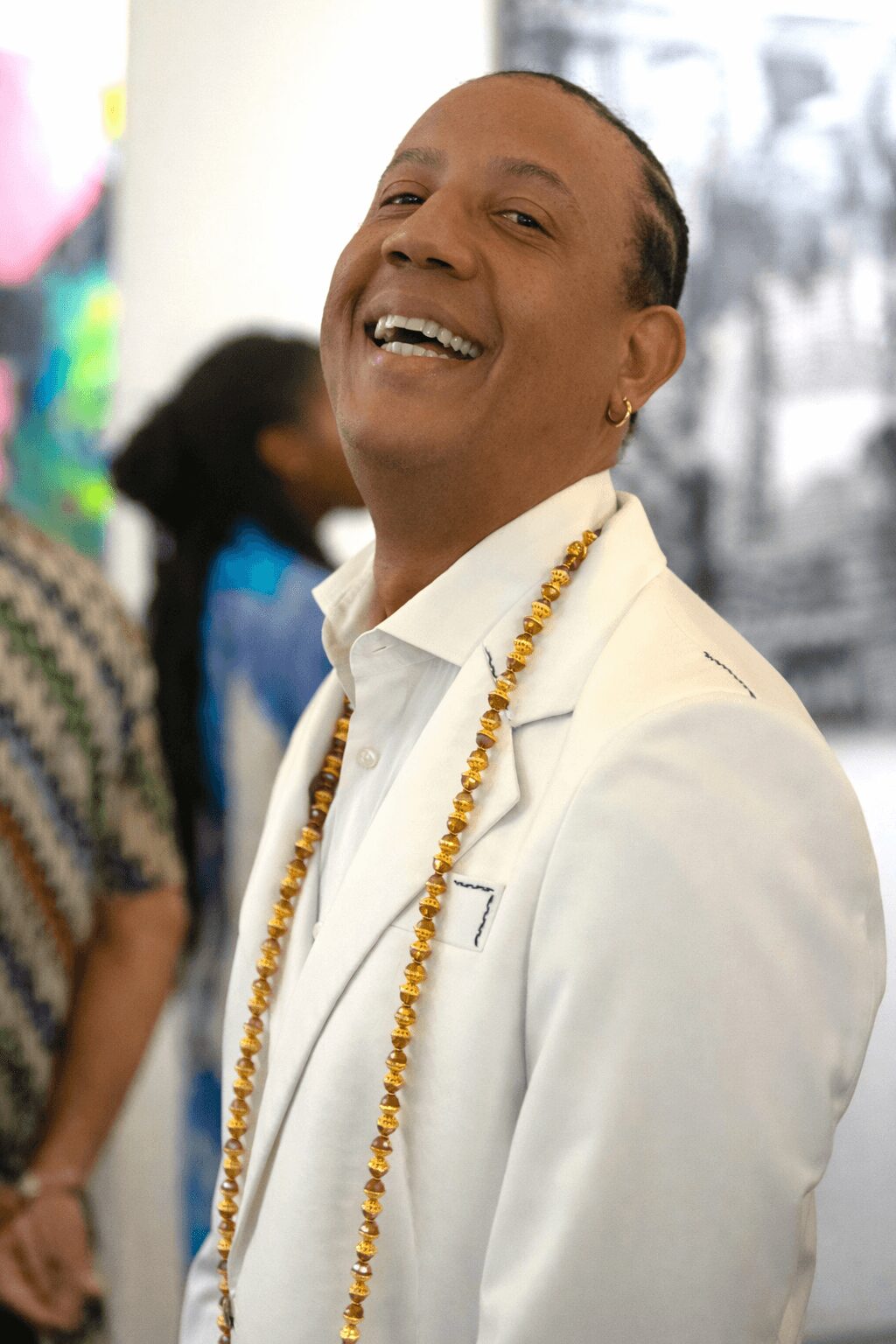
Today we’d like to introduce you to Alfonso D. Brooks.
Hi Alfonso D., we’d love for you to start by introducing yourself.
My story begins at the intersection of culture, curiosity, and a refusal to accept that global Africa’s contributions to world civilization were somehow optional in the global conversation.
I was born in Sint Maarten, raised with a deep awareness of the Caribbean as a living archive of African history, resistance, and creativity. That foundation shaped everything. I came to the United States carrying that consciousness, and I never let go of it.
In 1998, I founded Rockers Movement, which became the producing engine behind some of the most ambitious live cultural events in the country, including the Miami Reggae Festival and major productions at Madison Square Garden, the USTA Billie Jean King National Tennis Center, Forest Hills Stadium, Randall’s Island, and Bayfront Park in Miami. Nearly three decades of producing at that level taught me something essential: the infrastructure of culture is just as important as the culture itself. Who builds the stages matters. Who controls the narrative matters.
By 2015, that conviction formalized into AfriKin Foundation, Inc., a 501(c)(3) nonprofit African diaspora cultural institution. And in 2022, we established our permanent home, Maison AfriKin, at 1600 NE 126th Street in North Miami. Maison AfriKin is not just a gallery. It is a diplomatic and cultural post, a space where art, identity, and international exchange converge.
I have traveled to roughly sixty countries, and I frame that not as a personal achievement but as institutional research. Every visit to a market in Dakar, a ceremony in Benin, a museum in Cape Town, or a biennial in Venice feeds directly into the programming and philosophy of AfriKin. The world is our curriculum.
Today, AfriKin is in one of the most consequential chapters of its history. We are currently presenting “Art and the Beautiful Game: Africa on the World Stage,” our flagship FIFA World Cup 2026 cultural exhibition running June 1 through October 2, 2026, at Maison AfriKin. We are the signature African diaspora cultural institution on the Greater Miami Convention and Visitors Bureau’s official FIFA World Cup 2026 tourism platform. That designation did not come by accident. It came because we built something real, something credible, and something that the world is now ready to receive.
And we are just getting started. This fall, we present Taste of AfriKin on September 6, and our 12th Annual AfriKin Art Fair during Miami Art Week, November 29 through December 6, alongside African Fashion Week Miami, December 5 through 6.
The institution is in full expression.
The story is still being written. But the foundation is solid, and the vision is clear.
Alright, so let’s dig a little deeper into the story – has it been an easy path overall and if not, what were the challenges you’ve had to overcome?
Smooth? No. Necessary? Every step of it.
The road has been marked by the particular kind of friction that comes when you are building something that does not yet have a clear precedent. When you are an African diaspora cultural institution operating at the intersection of fine art, diplomacy, community, and international exchange, you are constantly having to explain your value to rooms that were not designed with you in mind. That is exhausting work, and I will not pretend otherwise, the world will catch up and the outsider will become the outlier.
The early years of Rockers Movement taught me that producing world-class events is only half the battle. The other half is convincing gatekeepers, funders, and institutions that your audience deserves the same investment, the same infrastructure, and the same respect as any other. We produced at the USTA We produced with Live Nation. And we still had to fight for every dollar, every partnership, every seat at the table. That reality does not disappear when your credentials grow. It just changes shape.
Building AfriKin Foundation and establishing Maison AfriKin in North Miami came with its own set of challenges. Nonprofit cultural institutions are chronically underfunded in this country, and African diaspora institutions bear a disproportionate share of that burden. We have had to be extraordinarily resourceful, extraordinarily strategic, and extraordinarily patient, often simultaneously.
There were moments of profound personal weight as well. Losses in the cultural world that reminded me why the work is urgent, not comfortable. I think about people like the late Koyo Kouoh, one of the most visionary curatorial minds the African world has ever produced, who visited Maison AfriKin before her passing. That kind of presence, and that kind of absence, sharpens your purpose in ways that no business plan can replicate.
What kept me going was the clarity of the mission. AfriKin exists because the African diaspora deserves permanent, dignified, world-class cultural infrastructure. Not a pop-up. Not a moment. A permanent institution. That conviction has never wavered, even when the resources, the recognition, or the timing were not aligned.
Right now, presenting “Art and the Beautiful Game: Africa on the World Stage” as the signature African diaspora institution on the GMCVB’s official FIFA World Cup 2026 tourism platform, running June 1 through October 2 at Maison AfriKin, feels like a direct answer to every door that was slow to open. We must remember that the spirit of football is more than just a game; it’s a way of life and the center of our community, a pathway to better days.
The struggle was not wasted. It was tuition.
Thanks for sharing that. So, maybe next you can tell us a bit more about your business?
AfriKin Foundation is a 501(c)(3) nonprofit African diaspora cultural institution operating as Maison AfriKin at 1600 NE 126th Street in North Miami, Florida. But to describe us only in those terms is to describe an ocean by its shoreline.
What we are, at our core, is a permanent home in Miami for global Africa’s relationship with art, identity, diplomacy, and cultural memory. We are a gallery, a convening space, an international exchange platform, and an institution builder, all operating under one roof and one unified vision.
We specialize in the kind of programming that refuses to separate aesthetic excellence from cultural consequence. Our exhibitions are not decorative. They are arguments. They make the case, through visual art, curatorial scholarship, and diplomatic engagement, that global Africa is not peripheral to world civilization. It is foundational to it. That positioning is what sets AfriKin apart. We are not presenting African and diaspora art as a niche offering for a niche audience. We are presenting it as essential content for a global one.
Our annual AfriKin Art Fair, now in its 12th edition and presented each year during Miami Art Week, has become one of the most distinctive diaspora-centered art events in the country. Miami Art Week is one of the most competitive cultural stages on the planet, and we have held our ground on that stage for over a decade. The 12th Annual AfriKin Art Fair themed “GRIOT: Urgent Storytelling for Our Times” runs November 29 through December 6, 2026, alongside African Fashion Week Miami, REGENESIS: The African Winter, December 5 through 6. These are not sideline events. They are destination programming.
Our summer exhibition this year, “Art and the Beautiful Game: Africa on the World Stage,” running June 1 through October 2, 2026, at Maison AfriKin, is perhaps the clearest expression of what AfriKin does at its highest level. We are the signature African diaspora cultural institution on the Greater Miami Convention and Visitors Bureau’s official FIFA World Cup 2026 tourism platform. We have secured a confirmed fashion runway partnership with PUMA, covering exhibition coverage for six nations including Ghana, Senegal, Morocco, Côte d’Ivoire, Egypt, and Portugal under the “Hidden Africa” designation. We are in active collaboration with the Consulate General of Brazil, with loan items connected to the Pelé Museum as part of the exhibition. Our Cabo Verde International Football Welcome Reception on June 20, anchoring the exhibition’s diplomatic programming, will welcome FIFA representatives, heads of government, and Consul Generals. This is cultural diplomacy executed at a level that very few nonprofit institutions anywhere in the country are operating at.
That brings me to the cohesion between the institution and the individual, because AfriKin and Alfonso D. Brooks are not separate stories. They are the same story told from two angles.
I am a published author of seven books. I am an independent executive festival producer with nearly three decades of experience on stages that include Madison Square Garden, Forest Hills Stadium, the USTA Billie Jean King National Tennis Center, and Randall’s Island. I have traveled to roughly sixty countries, not as a tourist but as a researcher, a cultural observer, and an institution builder gathering intelligence from every market, ceremony, biennial, and gallery I have entered. That body of experience is the intellectual and creative foundation on which AfriKin was built.
The recognitions have followed the work. AfriKin Foundation holds a GMCVB Letter of Support from Senior Vice President Connie Kinnard. I hold civic proclamations from multiple municipalities, including Alfonso D. Brooks Day, proclaimed by Mayor Alix Desulme of North Miami on February 24, 2026. In 2025, I received the Arts and Business Council of Miami Arts and Social Impact Award, a recognition that speaks directly to what we are building: an institution where artistic vision and civic impact are not in tension but are, in fact, the same thing.
What I want Voyage readers to understand is this. AfriKin is not waiting to be discovered. We are already operating at an international level, already in the room with diplomats, FIFA representatives, world-class artists, and cultural institutions across more than twenty nations. What we are building in North Miami is not a local story. It is a global one, and Miami is where it is headquartered.
If you want to experience it directly, Taste of AfriKin is on September 6, 2026, at Scott Galvin Center in North Miami. We will be offering palate pleasing food and beverages that will take you on a culinary journey through global Africa without the need for a passport. The AfriKin Art Fair opens November 29 and runs through December 6th as a part of Miami Art Week/Art Basel Miami Beach. And “Art and the Beautiful Game” is open June 1st through October 2 at Maison AfriKin. Come see what permanent African diaspora cultural infrastructure looks like when it is fully in motion.
What quality or characteristic do you feel is most important to your success?
Conviction that does not require consensus.
That is the quality I return to most often when I reflect on what has made the difference. Not talent alone. Not timing. Not connections, though all of those matter. What has been the through line across nearly three decades of producing, institution building, writing, and cultural diplomacy is the ability to hold a vision with absolute clarity before anyone else can see it, and to move toward it anyway.
When I conceived of AfriKin Foundation, there was no template for what I was describing. A permanent global African cultural institution in South Florida, operating at the intersection of fine art, international diplomacy, and community, presenting world-class programming during Miami Art Week, engaging consulates and representatives and museum loan programs simultaneously. People did not doubt the sincerity of the vision. They doubted its scale. And I understood that doubt. I just did not share it.
That kind of conviction is not arrogance. It is preparation meeting purpose. It is the result of sixty countries of travel as institutional research. It is nearly three decades of producing at the highest levels of live culture and understanding exactly how world-class infrastructure gets built. It is seven books worth of thinking carefully about global Africa’s place in history and in the present moment. When the vision is that well-researched and that deeply rooted, consensus becomes less necessary. Clarity becomes its own compass.
The second quality I would name, inseparable from the first, is precision. Everything we produce at AfriKin, every exhibition, every diplomatic letter, every partnership proposal, every curatorial statement, is held to a standard that assumes no margin for error. When you are operating as an African diaspora institution in spaces that were not originally designed to include you, you cannot afford to be approximate. Your documentation has to be flawless. Your partnerships have to be airtight. Your programming has to be undeniable. Precision is not perfectionism for its own sake. It is a strategic posture.
Those two qualities together, conviction without consensus and precision without compromise, are what allowed us to secure a confirmed PUMA partnership, earn placement on the GMCVB’s official FIFA World Cup 2026 tourism platform as the signature African diaspora cultural institution, build active diplomatic relationships with more than twenty nations, and present “Art and the Beautiful Game: Africa on the World Stage” running June 1 through October 2, 2026, at Maison AfriKin, at the level we are presenting it.
The vision was always this large. We simply kept building until the world could see what we already knew was there.
There is a freedom that comes when you stop asking for permission.
I want to call it the freedom of being absurd, because that is exactly what they called it, quietly, in the rooms where decisions get made, when I first described what AfriKin was going to become. And I wore that absurdity like armor.
The outsider who does not leave eventually becomes the outlier. And the outlier, if the work is real and the roots are deep, eventually becomes the institution. That is the arc I have been living. The scars are real. The sacrifices are documented. But every closed door and every underfunded season is load-bearing infrastructure for what stands today. I can say that without hesitation because the track record speaks for itself, and I have earned the right to speak with this level of confidence.
Miami has always been a city of arrivals. But for all of its diversity, it has been waiting for something specific: a permanent, world-class African diaspora cultural institution that does not apologize for its ambition. AfriKin is that institution. Maison AfriKin is that table.
And none of it sustains itself without community. AfriKin Foundation is a 501(c)(3) nonprofit, and the work we do depends on people who believe that African diaspora cultural infrastructure is worth investing in. Every exhibition, every diplomatic relationship, every young person who walks through our doors and sees themselves reflected in world-class art is only possible because someone chose to stand with this mission.
If that someone is you, we welcome you.
Make your donation at afrikin.org/donate.html.
The outsider built the institution. Now help us sustain it.
Contact Info:
- Website: https://afrikin.org
- Instagram: https://instagram.com/afrikinnation
- Facebook: https://facebook.com/afrikinnation
- LinkedIn: https://www.linkedin.com/in/alfonsobrooks/
- Twitter: https://x.com/afrikinnation
- Youtube: https://www.youtube.com/afrikin
- Yelp: https://www.yelp.com/biz/afrikin-north-miami?osq=afrikin
- Other: https://alfonsobrooks.com