





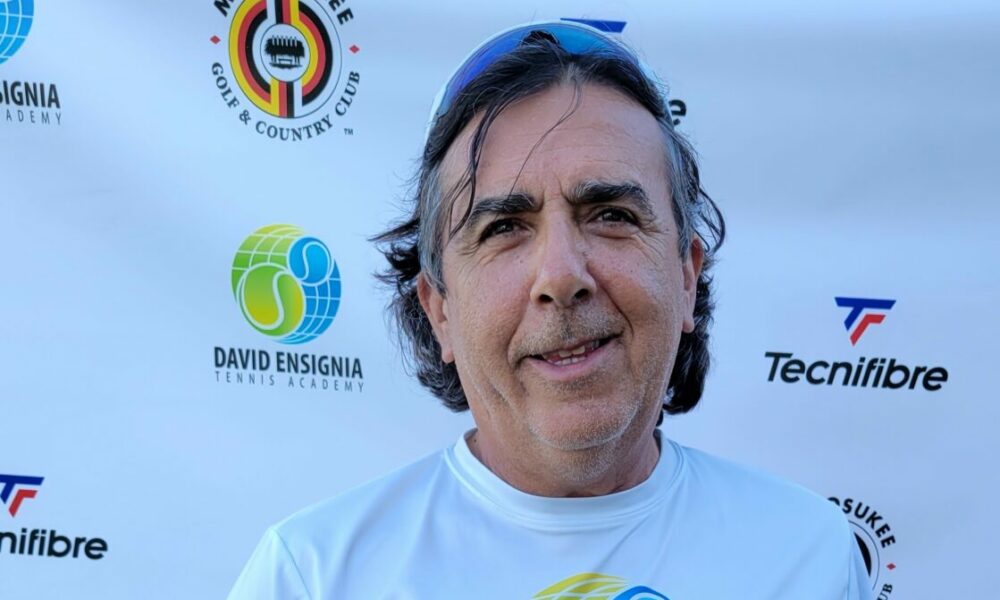
Today we’d like to introduce you to David Ensignia, Sr.
Hi David, so excited to have you with us today. What can you tell us about your story?
In the 70s, tennis became my passion. I lived in Chile, a very depressed country at that time, due to a military dictatorship that existed. It was depressing in every way: economically, morally, socially, and politically; of course, in those years, there didn’t exist the communication that exists today. Someone told me that I could receive a tennis scholarship from a university in the United States.
But I didn’t have any contacts, so I just decided to get a degree in business and administration. When I graduated, I got on a plane to Venezuela, where my older sister lived. It was my first time leaving Chile and the first time I got on a plane. I was just 21 years old. I arrived in Venezuela, and that seemed like fantasyland. It was all wonderful. It was all color and sun. It was like the Caribbean. It was another philosophy of life. The people of Venezuela were extremely supportive of me and receptive, not only with me but with many of my compatriots. And until that minute, my passion was still tennis. I made some contacts in Venezuela, and I started giving tennis lessons.
I was an assistant in a club for a couple of years, and then I moved to the city of Puerto Audaz, where I worked. There was a large steel company and a big power plant called Guri, which was also the largest in South America at that time. There were many foreigners living there. There was a lot of work but very little entertainment. That meant that I did very well. I had a lot of work and saved a lot of money.
Then, I moved to Maracaibo and later to Barquisimeto, always as a tennis pro at a club. I always did very well. But being an employee greatly limits your future projections, imagination, and what you can do. So, I decided to stop working for someone else and start working for myself, and at that moment, I developed what is now David Ensignia Tennis Academy. I modeled my first tennis academy in 1987 from a concept I copied from here in the United States.
I was very familiar with tennis academies from my summers in Bradenton, Florida. I learned the concept and developed it in Venezuela. At that time, it was the first tennis academy in Venezuela. I developed my concept, negotiated with people, and gained a tremendous amount of experience.
Even then, my results were good. We had great players and talented coaches and competed at a high level. In fact, at the junior level, there are eight categories and eight champions. Of the eight champions in Venezuela then, my academy had five or six number-one players. We practically controlled tennis instruction in Venezuela. But personal issues prompted me to leave Venezuela and take my two children somewhere safer and more secure. My goal was to move to Bradenton. However, a business opportunity outside the sport came up in Miami.
I was nearly 50 at the time. I thought maybe it was time for me to change my job to something safer and less strenuous. So, I quit tennis and opened an embroidery, stamping factory dedicated to producing products for export to the Caribbean. I had that business for 12 years and then lost I all. I lost my house. I lost absolutely everything, everything. Then I remembered tennis.
In 2007, I opened David Ensignia Tennis Academy. And here we are today, with a lot of effort, with many hard days in the sense that things did not turn out as expected. We worked for many years to make ends meet, then something happened; I met the woman who is my wife today (Jacit Gonzalez). After begging her a lot, she decided to work with me. This is a shared job where Jacit and my son David are both essential. Then various things came together:
- My crazy dream
- My son David’s youth and enthusiasm
- Jacit’s youth and her executive experience
Challenges: The academy was very successful in Venezuela, but that was a different Venezuela and a different time. When you do things first, things work out better because you’re selling something new. It’s not the same here in Miami. Miami has the biggest competition in the world. It has the best coaches in the world. Everyone comes here because of the facilities, the pros, and the climate.
They come from Europe and South and Central America. They come from the Caribbean. So, everyone who plays tennis comes to Miami and Florida. Florida and California are the two largest tennis states in the United States.
Would you say it’s been a smooth road, and if not, what are some of the biggest challenges you’ve faced along the way?
There were obstacles by the millions. First, the language, then the contacts, then the bureaucracy. Then there’s the competition, which is tremendous. That’s why succeeding here in Miami hits differently. It has much more merit. Jacit and my son David are an essential part of the team.
If it weren’t for that team we managed to form; we wouldn’t be as successful as we are now. Their collaboration has been vital. The academy is the most important thing. Because of how we are creating the academy and developing it day by day, it will surpass my existence and that of other people. The academy is not me. The academy is an institution that bears my name because I had the idea 37 years ago.
The academy is going to transcend me.
Thanks for sharing that. So, maybe next you can tell us a bit more about your business?
What are you most proud of I’m very proud of the team we’ve formed.
Definitely, for reasons of age, the academy has my name. Because I started it, I’m the oldest. But I’m very proud of what we have achieved now, together with Jacit and my son.
We all have different ways of looking at and defining success. How do you define success?
I want them to know we are very professional. For us, although money indeed moves us because it is our economic activity, it is not what is most important. What is most important for us is the service we provide.
We want to leave a mark. Children from other academies often come to play with us and tell us that they took classes with other teachers for two or three years, yet they don’t know anything about tennis. That makes me very sad. I don’t want the same to happen to a child that has been with us. I try to have that registered trademark in our students. So, when another teacher sees one of our students, they know this child has been well taught.
We understand the economic effort that parents make for their children to take lessons. More than an expense, we see it as an investment because tennis is not just a physical activity or a sport; it is a lifestyle. It is a lifestyle that teaches you discipline, teaches you a system, gives you character, teaches you to respect your body, teaches you to respect your adversary, and teaches you to get up each time you fall. There are many more times that you fall, and you have to stand again, and you have to get yourself together, and you have to start again, compared to the times you lift a trophy, and that’s life.
You always have to keep getting up. And you have to keep doing something new. A while ago, we had a project for a type of court, and somebody told me: Put pickleball. Pickleball opens doors to senior people and I didn’t think twice. We added pickleball and today we have given a lot of people the opportunity to play pickleball, especially senior adults. We encouraged them to be on the pickleball court. It’s been transformative.
They make friends. They have fun. And the children with us in the academy have a good time. We even have students who get so good they receive college scholarships to play, which paves the way for their education. We couldn’t be prouder. I love seeing a child smile and say thanks. It is to see that our activity has reached many people. It’s to see that we changed the lives of people in general.
Contact Info:
- Website: davidensigniatennis.com and detapickleballclub.com
- Instagram: https://www.instagram.com/davidensigniatennis and https://www.instagram.com/detapickleballclub/
- Facebook: https://www.facebook.com/davidensigniatennis
- Youtube: https://www.youtube.com/@davidensigniatennisacademy99 and https://www.youtube.com/@DETAClub


 Image Credits
David Ensignia Tennis Academy, David Ensignia Sr., David Ensignia Jr, Patricio Cornejo, and Emilio Seelbach