





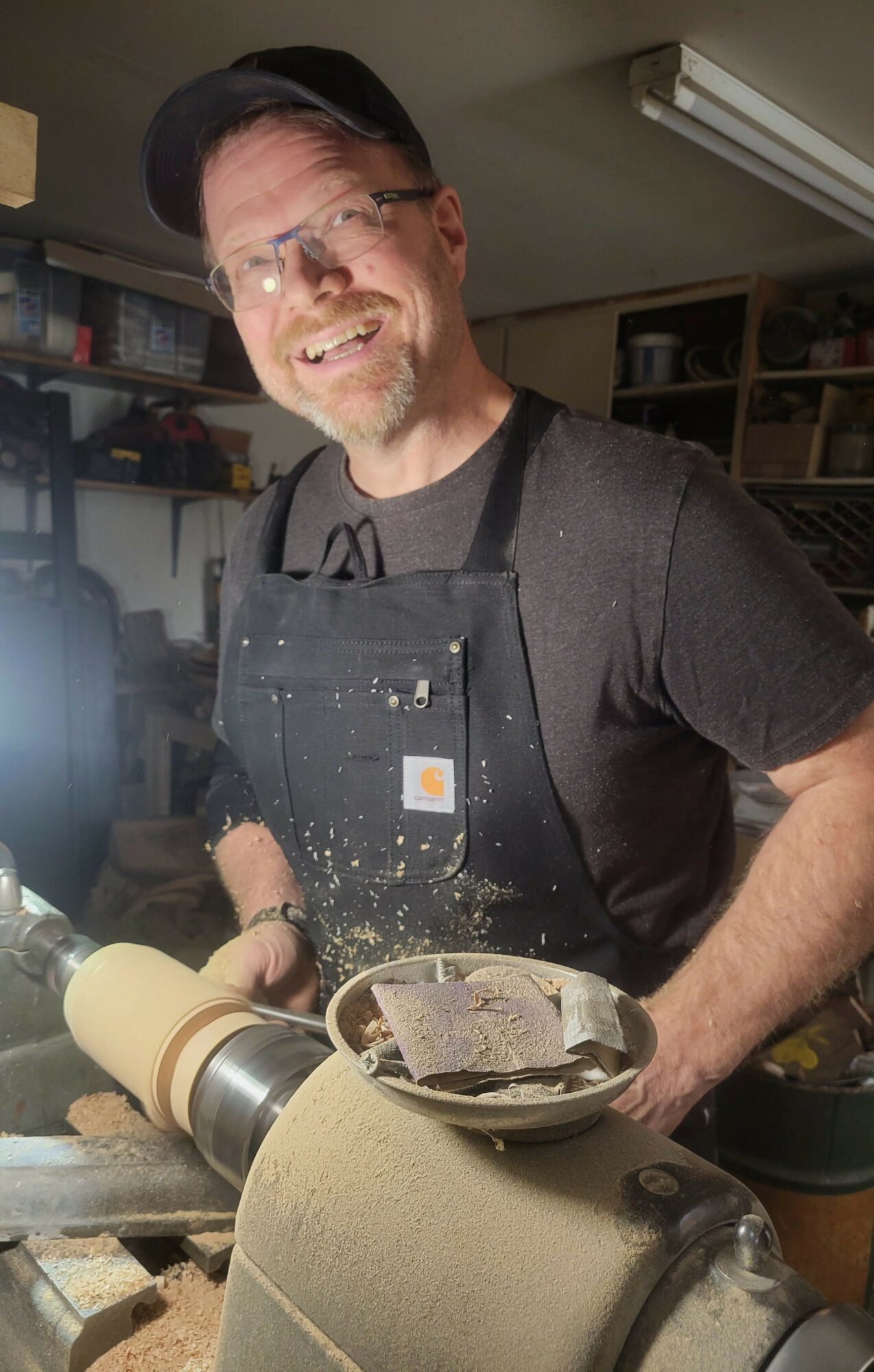
Today we’d like to introduce you to Douglas Hill.
Hi Douglas, thanks for sharing your story with us. To start, maybe you can tell our readers some of your backstory.
My journey began at 16 as a carpenter’s apprentice in northern NJ, where I spent a decade learning the fundamentals before mastering the carpentry and woodworking craft. I worked as a carpenter and contractor for over 30 years, renovating, remodeling, and building homes in Northern New Jersey. But in 2017, I made a pivotal decision: to focus exclusively on creating fine woodwork that allows my creativity to flourish, establishing Grayhill Woodworking LLC.
I don’t force the wood into submission — I listen to what each piece wants to become. The wood speaks: it provides natural lines, voids, and character, and my hands translate that into a beautiful piece. My preferred tool is the lathe, where I turn wood into a vase, bowl, or sculptural piece. However, with my carpentry background, I’m fluent in every tool in my shop.
This philosophy shines through in every unique piece I create — from turned bowls that showcase nature’s perfect imperfections to custom furniture designed specifically for each client. My versatility with the lathe, carving tools, and traditional carpentry techniques allows me to craft everything from elegant dining accessories to statement furniture pieces.
What truly sets Grayhill Woodworking apart is the story behind each creation. Approximately 99% of my wood material comes from reclaimed sources — trees that fell during storms, wood rescued from demolition sites, or leftover materials from construction projects. Each piece carries its own history, preserved and transformed rather than discarded.
Customers often remark on the tactile experience of my pieces — the surprising smoothness that doesn’t sacrifice the wood’s natural warmth and character. Many are drawn to specific pieces after hearing their origin stories, like the “Legacy Collection” pieces, whose history and natural grain pattern are reflected in the beautiful cherry wood they’re created from.
We all face challenges, but looking back would you describe it as a relatively smooth road?
Yes and no. I love what I do — I love carpentry, transforming a piece of wood into something new, different, beautiful, and even functional. I started as an apprentice carpenter at age 16. There has been a lot to learn along the way, from calculating materials to laying out, measuring, marking, and cutting. Over the course of my four-decade career, I have certainly made a lot of mistakes and learned many lessons, but perfecting my skills has always been paramount.
I would say overall the road has been smooth, but the struggles along the way are figuring out how to get to the end product that is envisioned. In carpentry, there is a general way of working; in woodworking, there is much more flexibility and creativity. Learning new tools, new methods, and staying in tune with the needs of customers — I would say that’s just part of the job, part of what I love, and part of being a business owner. Are they struggles? Not necessarily, as I embrace them.
If I had to name the biggest struggle, it’s building a business from the ground up. In today’s world of online shopping, it’s hard to break through the clutter and the “immediate gratification” of large online retailers. I have two major ways customers can shop with me — my online shop or in-person art shows — and keeping both running is its own balancing act. I’m a one-person shop, so juggling custom orders, keeping my online shop stocked, and having enough inventory for shows all at once is a real challenge.
The other struggle is education. Most people are used to mass-produced items, so it can be hard for them to grasp that everything I make is handmade, by me, out of reclaimed material — one-of-a-kind, unique, or small batch. Even small-batch pieces won’t look exactly like each other, unlike mass-produced goods. What I hear most often is, “I can get a wood bowl off Amazon for a fraction of the price.” Of course you can — it was mass produced, most likely overseas, in a factory using harvested and processed wood. Getting people to understand the value of handmade work versus mass-produced is an ongoing challenge, but it’s one I take head-on rather than shy away from.
Can you tell our readers more about what you do and what you think sets you apart from others?
I am a woodworker, carrying on a family trade that goes back three generations. I picked up my first tools at 16.
Over the course of my career, I have built and renovated homes in northern New Jersey, and in 2017 I transitioned from home remodeling and renovating to full-time woodworking. Woodworking has been a practice I did as a hobby throughout my life, starting in high school shop class.
I specialize in functional and sculptural wood-crafted pieces for the home. For example: home decor (vases, urns, decorative vessels, etc.), functional work (bowls, sushi servers, cutting boards), and artistic pieces (sculptural work, wall-hanging art). All my work is one-of-a-kind or small batch. I work almost exclusively in reclaimed wood material, and often “from the tree” — meaning most of my material is sustainably reclaimed and acquired as actual tree logs, branches, and cuttings, which I process into blanks and boards, naturally dry, and then turn into a final piece. Most of the wood material I reclaim would have otherwise ended up in the landfill.
I consider my work special in two ways. Each piece is singular — it cannot be closely replicated due to the unique characteristics of that specific piece of wood. And it’s original in that it’s my design; I can make another, but no two will ever be exactly the same because of the nature of wood itself. Every piece of wood is different — I can change the species, or use the same species and still see the grain differ (even wood from the same exact tree), along with different imperfections in the wood, and perhaps a stain for color or resin.
What I am most proud of, and what sets me apart, is that everything is done by me. I don’t have an apprentice or shop helper. I am a one-person shop, and the only assistance I have is my wife, who manages the “business side of things,” as she calls it. I acquire all the wood, assess each piece, process it, store it for drying, design, create, finish, and quality control each piece. Quality control is incredibly important to me, and each piece must match my exacting standards.
My primary method of selling is my website, as well as art shows, where I have the opportunity to interact with customers directly. Since I am intimately familiar with each piece, I can talk about the wood itself — the species, characteristics, how it will change over time (i.e., cherry will patina over time), the challenges with different wood species, specifically where the tree came from (often down to the specific address), the design process, any challenges in creating the piece, or what inspired the specific piece the customer is interested in. When you shop mass merchants, you don’t get that — you don’t get the story, the history. Details matter. I love using locally reclaimed wood material; the story of the wood is part of the piece.
Can you talk to us a bit about the role of luck?
That’s a great question. I am lucky to have had the opportunity to develop my skills over the last four decades. My family is incredibly important to me, and their support of my craft has allowed me the opportunity to develop my skills and change directions so I am fulfilled in the work I do. I’m also lucky that this trade runs in my family — I learned from the best. My father and uncle specifically were inspirational and important teachers throughout my career. I have been able to leverage the base skills they taught me and turn it into not just one but two businesses through my career (I was a home improvement contractor before I transitioned my business into full-time woodworking).
As for bad luck, I can’t point to anything specific — more just the normal hard knocks that come with building two businesses over four decades. I’ve been fortunate that the challenges I’ve faced have been the kind you work through with time and persistence, rather than anything that knocked me off course.
Pricing:
- Items range from $50 to $5000 on my site.
Contact Info:
- Website: https://www.grayhillwoodworkingllc.com/
- Instagram: https://www.instagram.com/grayhill_woodworkingllc/?hl=en
- Facebook: https://www.facebook.com/GrayHillWoodworkingLLC