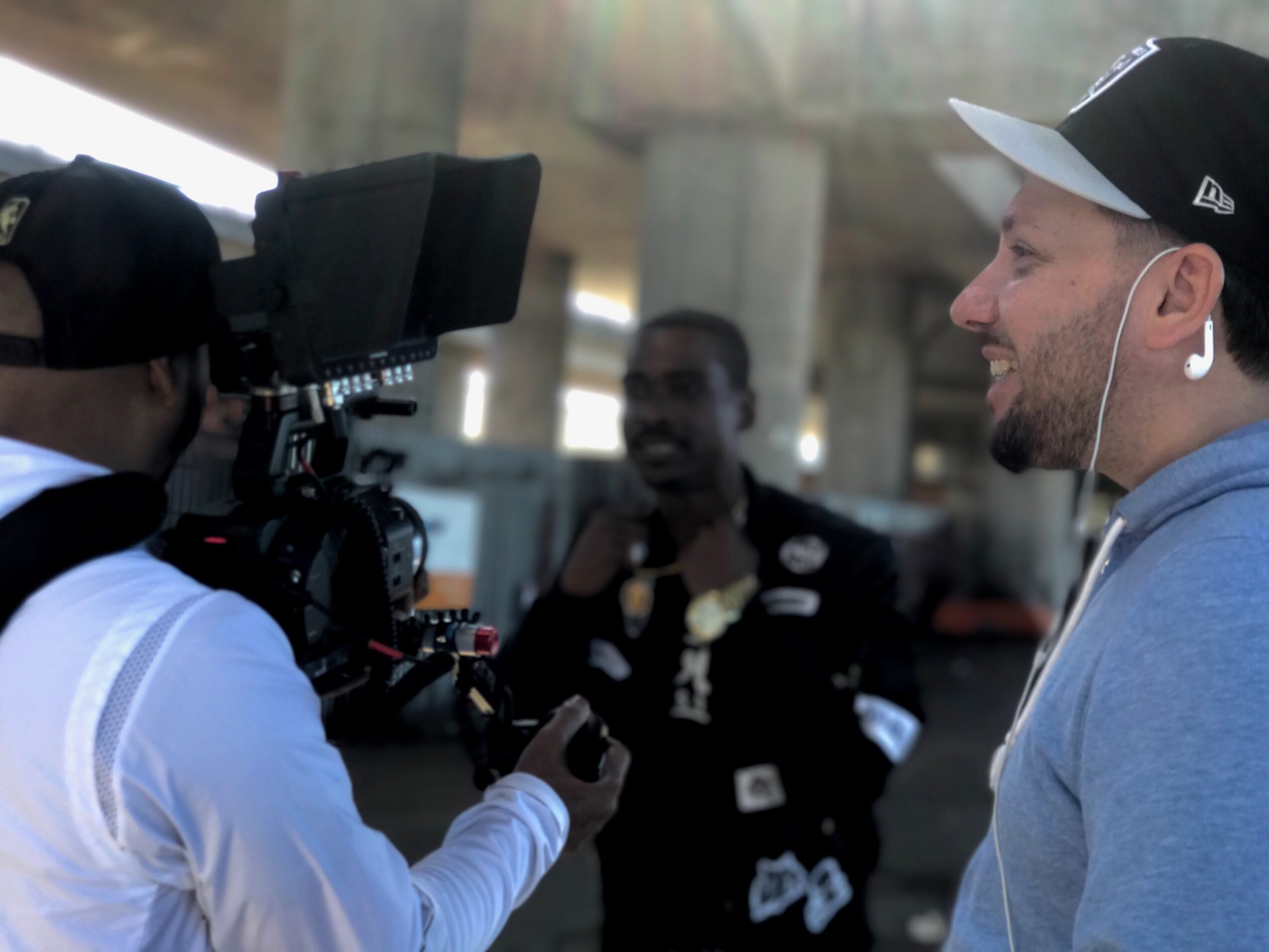




Today we’d like to introduce you to Giovani Hidalgo.
Giovani, we appreciate you taking the time to share your story with us today. Where does your story begin?
I definitely didn’t take the traditional path into filmmaking. When I was in high school, I was a knucklehead. I got kicked out of a couple of schools, dropped out for a period, and spent more time hustling and running around than thinking about my future. Eventually, I ended up at my sixth high school, Foothill High, a continuation school, where I was seriously behind on the credits I needed to graduate.
That’s where I met a teacher named Mr. Gordon. He saw something in me and pushed me to get my diploma. During my senior year, he helped me transfer to Pegasus High, where I finally felt like I was getting back on track to graduate.
Then things got complicated. Mr. Gordon wouldn’t give me the final five credits I needed for a government class I had already taken, so I was forced to retake the entire course. And to make it worse, at the beginning of the class, he ripped up the first credit I had already earned, meaning I had to make that one up somewhere else, too. I remember thinking, I’m not doing another book report.
So instead, I decided to make a video.
I had previously attended James Lick High, which had a radio and video program, so I reached out to them for help. They pointed me toward a teacher at Pegasus named Mr. Tatum. The next day, he showed me a tiny makeshift editing room in a closet with an old computer, a VHSC camera, and an early version of Avid.
I was hooked.
I made a short documentary about the first chapter in the government book, interviewing friends, family, people in my neighborhood and random people I met. Mr. Tatum taught me how to shoot, edit, use music and, most importantly, tell a story. The hard drives constantly crashed and I had to start over several times, but I didn’t care. I was obsessed.
I never finished the video before graduation, but Mr. Gordon saw how hard I had worked and gave me the final credit I needed. I graduated early, and that little unfinished project completely changed the direction of my life. For the first time, I knew what I wanted to do: become a filmmaker.
I had no idea how to make that happen, so I worked whatever jobs I could get record stores, sign shops, restaurants, shipping, you name it and saved every dollar. I eventually bought my first Mac desktop and Final Cut Pro and taught myself everything I could. Mr. Tatum continued mentoring me, spending countless hours teaching me editing and storytelling. I honestly owe him a lot because if it weren’t for him, I may have never discovered filmmaking.
Then, on November 30, 2001, I took the $150 I got for my birthday, went to the City of San Jose and got a business license. That was the beginning of my first production company, Rush Films. My first office was my bedroom, and every dollar I made went right back into the company. I saw a void in the Bay Area and decided to do a music video show on public access TV to help fill a void by showcasing our local artists’ interviews and music videos. Then shortly after that the Hyphy movement started and I started shooting their music videos. By 2006, I had two “Jam of the Week” videos on MTV Jams and a MTV2 premiere. That run changed my career forever.
Looking back, the funny thing is that everything I thought was working against me was actually pushing me toward the path I was supposed to be on. Getting kicked out of school, struggling to graduate, and having my credits taken away ultimately led me to Mr. Gordon, who pushed me to graduate, and Mr. Tatum, who introduced me to filmmaking.
From there, I took it and ran with it.
I really believe I turned lemons into lemonade. What started with a kid who couldn’t stay in school ultimately became a career in filmmaking.
We all face challenges, but looking back would you describe it as a relatively smooth road?
One of the biggest challenges of working in television and entertainment is that you can spend years creating, pitching, developing, and retooling a project, and sometimes the difference between something getting made and not getting made simply comes down to timing. You can have a great project, the right people involved, and real interest from a network or streamer, and it still might not happen.
I’ve experienced pretty much every version of that. I’ve had projects get green-lit and then suddenly get canceled. I’ve had development deals in progress that ultimately didn’t move forward. I’ve dealt with business partners who took development money and disappeared, and I’ve even had high-profile executive producers take projects out from underneath me. Those experiences can be devastating, especially because a lot of the projects we create are essentially self-financed through sweat equity. We’re putting our own time, money, relationships, and energy into these ideas with no guarantee that we’ll ever see anything back.
The hardest part isn’t necessarily hearing “no.” It’s investing years into something, getting incredibly close, and then having circumstances outside of your control bring it to an end. You have to be able to pick yourself up, figure out what went wrong, learn from it, and start building the next thing.
But honestly, I think the love of the game is what has kept me going. There’s something addictive about taking an idea that exists in your head, developing it into a real television series, building a team around it, pitching it to executives, and getting closer and closer to that moment when someone finally says, “Let’s make this.”
I haven’t sold a television series yet, and I’m completely comfortable saying that. I’ve been doing this for a long time, and I’ve gotten close enough to know that I’m not far away. I feel like I’m standing right at the doorstep. Eventually, the timing, the project, and the right opportunity are going to line up and my number is going to get called.
Until then, I’m going to keep creating, keep pitching, keep learning, and keep knocking on the door. Because if you really love what you do, you don’t stop just because someone hasn’t opened the door yet.
Can you tell our readers more about what you do and what you think sets you apart from others?
I’m probably known for a few things, and one of them is actually getting music videos banned from television. I created several projects with Killer Mike, including “Pressure” and “Burn,” as well as Ice Cube’s “Gangsta Rap Made Me Do It,” and all of them ended up getting banned from MTV and/or BET.
Honestly, looking back, that’s probably one of the things I’m most proud of. Not because the goal was necessarily to get banned, but because we were pushing the envelope hard enough that people had a reaction to what we were creating. I’ve always believed that if you’re going to make something, it should make people feel something whether they love it, hate it, or have a problem with it.
But within the industry, I’d say I’m probably best known for being someone who gets shit done. I’ve built my career around being able to walk into complicated situations, figure out what needs to happen, and somehow get the project across the finish line on time and regardless of what gets thrown at us. Production is rarely perfect. Things go wrong, people drop out, budgets change, locations fall through, schedules get compressed. My reputation has always been that when there’s a problem, I’m going to solve it.
At the end of the day, I’m proud of the provocative work, the artists I’ve been able to work with, and the moments where we pushed boundaries. But I’m probably even more proud of the trust people have in me to actually deliver. Ideas are easy. Getting them made is the hard part and that’s always been my strength.
Risk taking is a topic that people have widely differing views on – we’d love to hear your thoughts.
When I think about risk, one of the biggest risks I’ve taken professionally was deciding to stop doing things the way the industry traditionally tells you they have to be done.
For years, the conventional path to getting a television project in front of a network or streamer was to partner with an established production company that had a track record of selling shows, attach a heavyweight executive producer, or go through an agent or other representative who could submit the project for you. I understood why that system existed, and I spent years working within it. But eventually I reached a point where I thought, fuck it. I wanted to have more control over the projects I was creating. I wanted to be the person deciding when a project went out, who it went to, and how it was presented. More importantly, I wanted to build my own relationships with the people actually making decisions at the networks and streamers.
So I took a risk and started reaching out to them myself.
One email I sent to an executive at Apple ended up opening a door that led to relationships with the unscripted team there and then I gained enough confidence that my shot in the dark email worked that I kept doing it and I gained access to executives across the majority of the major networks and streamers. That completely changed the way I approached my career. Instead of creating a project and then waiting for someone else to decide when they thought it was ready to take out, I started taking ownership of that process myself.
Now, when I finish a project that I believe in, I don’t necessarily wait for an agent, producer, or partner to tell me when the timing is right. I take it out. I make the calls. I send the emails. I build the relationships. I put myself in the room.
That doesn’t mean I don’t value partnerships or representation. I absolutely do, and there are situations where having the right partner can make a huge difference. But I learned that I didn’t have to sit around waiting for someone else to give me permission to pursue opportunities.
For me, that’s what risk-taking is really about. Sometimes the biggest risk isn’t doing something crazy, it’s deciding to step outside of the established system and bet on yourself. You have to be willing to hear “no,” make mistakes, and occasionally get your ass kicked. But I’d rather have control over my own destiny and know that I took the shot than sit around waiting for somebody else to decide when I’m allowed to take it.
Contact Info:
- Website: http://www.giosworld.com
- Instagram: https://www.instagram.com/giosworld/
- Facebook: https://www.facebook.com/giosworld
- LinkedIn: http://www.linkedin.com/in/giovanihidalgo
- Twitter: https://twitter.com/gios_world
- Youtube: https://www.youtube.com/user/ingiosworld