




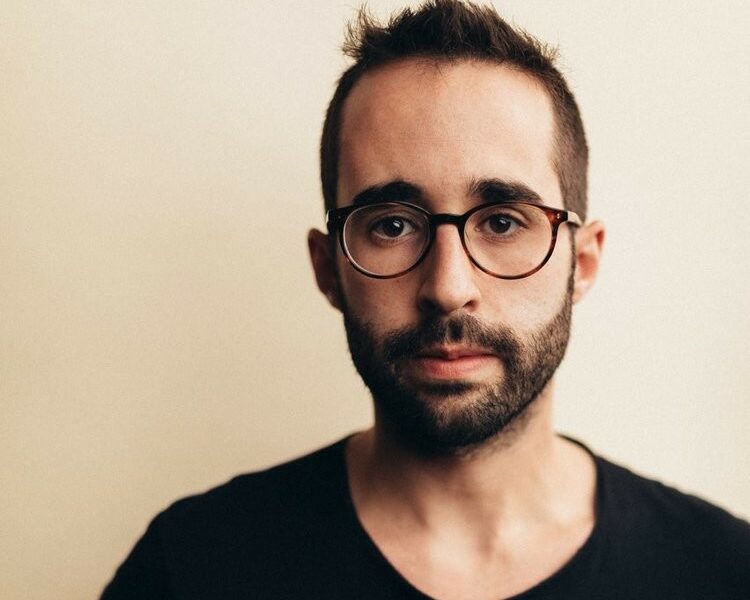
Today we’d like to introduce you to Frank Oliva.
Hi Frank, we’re thrilled to have a chance to learn your story today. So, before we get into specifics, maybe you can briefly walk us through how you got to where you are today?
I was born and raised in Miami to a very loving Cuban family. I come from a long line of doctors, lawyers and judges, with a notable exception being my paternal grandfather, who was a painter, illustrator and designer in Cuba (later in exile in Miami.)
I became totally obsessed with my grandfather’s work as a child – how he used color and light so vividly to create abstract expressions of community, love, hope and family. There was something about how the work brought people together and provoked conversation, even though my grandfather passed before I was born. (To this day, that dynamic is what drives my artistic practice.)
My family encouraged my curiosity, taking me to all of the theatre, ice shows, ballet, opera, circus and art expos that would come through town. I look back fondly on this formative time and see it as the moment that I was just enamored and enthralled by everything I saw. I consumed it and was always craving more.
I never thought of stage design as a career – and it took a while for me to find it. As I grew up, I realized that I liked so many different media – architecture, film, visual art, installations, fashion, dance, music – and of course live theatre. I discovered Stage Design as a medium that exists at the crossroads of all of that. Something about the fluidity and variety of the medium excited me, as well as the temporality of it.
I was lucky to have incredible mentors and teachers, both in school and outside, who gave me tremendous opportunities to practice my craft. And the more work I made, the more obsessed I became. I designed 10+ shows at my high school, Belen Jesuit Preparatory, who had this amazing generation of theatre kids while I was there, despite being an all-boy, largely sports-dominated school. It gave me real experience in putting on shows and working creatively and critically to produce something meaningful.
When I was 16, I took a summer job at the renowned Area Stage Company, who were just starting a conservatory for young people. John and Maria Rodaz took me in and saw the passion I had for design, and very generously gave me my first professional experiences.
From there, I received a scholarship to attend New York University’s Tisch School of the Arts, where I kept learning and growing, receiving a BFA in Theatrical Design. And it was how NYU’s innovative program, which blended classwork with internships that set me up for a career in New York.
I started as an intern in various design studios, working for theatre and opera designers Andrew Lieberman, Laura Jellinek and Lex Liang. I quickly rose through the ranks of intern to studio assistant Assistant Designer. After some years, I became an Associate Designer on Broadway, working alongside designers Jan Versweyveld and Anna Fleischle-Marriott, overseeing the day-to-day happenings of designing a Broadway show. All invaluable experiences.
While I was assisting other designers, I kept meeting young directors and producers, forming relationships that have grown into large projects of my own. The duality of assisting and designing on my own has prepared me to form and develop a busy artistic practice of my own.
I now run Oliva Design Group, which is a full-service design firm specializing in Theatre and Live Entertainment, with additional work in Events, Film and Music.
I’m sure you wouldn’t say it’s been obstacle free, but so far would you say the journey have been a fairly smooth road?
One challenge came when I was first exploring stage design – I didn’t know who designed the shows, where they worked, how to contact them or really that this was even a career! It took a while for me to put the pieces together, do research and find my way in. I also later discovered that a team of designers frequently worked together – so a lot of my early work was me designing everything.
Further down the road, I realized how underfunded the performing arts can be, even as compared to visual art or architecture. I had to do a lot of strategizing early in my career about how to find sources of income to live sustainably, pay my bills and also to buy back my time to make the work I wanted to make.
The ongoing challenge of being a designer is that we’re freelancers. We take on jobs all over the place, at varying scales and with varying parameters. It’s a challenge to figure out what your bandwidth really is, how many projects you can have going at once and identifying the tools and support you need to build a practice. I struggle with this DAILY! Part of it has to do with letting others into my process to support me. I’ve had to hire assistant designers, drafts-people and model-makers to help get the work done. When you’re young and starting out, you do everything yourself. Now as I have built a firm and a larger practice, I just can’t do it all anymore. It continues to be a learning process.
Appreciate you sharing that. What else should we know about what you do?
I’m a stage designer for theatre and live entertainment. It’s a pretty broad job title – and that’s part of what I love about it. I design the physical environment for plays, musicals, opera, dance, live music, events and experiences. When you walk into a venue, most of what you see I’ve worked on.
I specialize in narrative and immersive environments. I tend to look at projects through the lens of an audience member, and my work tries to elicit some kind of response from an audience. Sometimes it can be very obvious from the beginning if the design makes a really bold statement. Other times it can be more subdued or muted, depending on the energy of the play. And some other times, I try to surprise an audience halfway through the piece with something unexpected. My work is narrative, thinking about how space evolves over time to tell a story.
What sets me apart is that I detest traditional stage design conventions. My work isn’t about illustrating a location or just telling an audience, “Hey, this is France in 1900.” Rather, I’m invoking how that space might feel and how it translates visually. It can sometimes be really abstract and gestural – but it starts from a feeling, something that’s maybe somewhat indescribable.
My work has been called “minimalist” and “architectural” in the past – but I somehow don’t identify with either of those descriptions.
Networking and finding a mentor can have such a positive impact on one’s life and career. Any advice?
I found mentors by seeing a lot of different kinds of work. It exposed me to entire new sub-genres of performance while creating a short-list of the people I wanted to work for and learn from. It also trained me in how to talk about what I saw, what I liked or didn’t like about it, and what about it provoked my thinking.
My biggest piece of advice for finding a mentor would be to do your research about this person and reach out when you have a clear idea about why you’re reaching out. Going into those meetings with a real purpose shows not just that you’re a fan but that you’re invested. Mentorship is a two-way street, and it’s useful not just to show that you can be an asset to this person but that you’re curious and excited by what they have to offer. Think about the structure of the mentorship to – are you going to work for them? Are you just observing? Do you want to have a couple of meetings and that’s it? Be clear about what your expectations are, and then listen for a response.
Most importantly – be brief. A short email intro with a few sentences summarizing who you are, what you do and what you’re asking for goes a whole lot further than several paragraphs. If your email is too long, it runs the risk of being forgotten quickly, especially if your mentor is particularly busy.
Contact Info:
- Website: www.frankjoliva.com
- Instagram: @frankjoliva


Image Credits
Personal Photo Photo Credit: Emilio Madrid Additional Photos: #1 TOSCA Molloy College Directed by Marcus Shields Set Design & Photo by Frank Oliva #2 LOST NOT FOUND by Kirby Fields UP Theatre Company Directed by Alex Keegan Set Design & Photo by Frank Oliva #3 THE NORMAL HEART by Larry Kramer Curtain Call Theatre Directed by Carol Max Set Design & Photo by Frank Oliva #4 THIS BEAUTIFUL FUTURE by Rita Kalnejais TheatreLab Directed by Jack Serio Set Design by Frank Oliva Photo Credit: Emilio Madrid #5 PAPA CUATRO by Juan Souki Miami New Drama Directed by Juan Souki Set Design & Photo by Frank Oliva #6 HAIR by Galt MacDermot, Gerome Ragni and James Rado Weston Theatre Company Directed by Susanna Gellert Set Design by Frank Oliva Photo Credit: Scott Zielenski #7 BE MORE CHILL by Joe Tracz and Joe Iconis Area Stage Company Directed by Giancarlo Rodaz Set Design & Photo by Frank Oliva #8 BLACK EXHIBITION by Jeremy O’Harris The Bushwick Starr Directed by Machel Ross Set Design by Frank Oliva Photo Credit: Maria Baranova